




Football has been on the rise since it first became a game. Hundreds of championships each year. A FIFA World Cup every four years. Thousands of players fighting to make their team the best. This did not happen overnight. And neither did the rise of real-time football applications. Today, most of these platforms run on a football API. The API is the backbone. It is what feeds live scores, match events, player stats, and standings into the product in real time. Whether you are building a football live score API integration, a football fantasy API platform, or an odds product, how fast and accurately your football API optimization strategy delivers that data is what defines performance.
Choosing an inefficient football API provider does not just slow things down. It costs you. Delayed live scores. Laggy fantasy apps. Stale betting odds. Overloaded backend systems. The damage shows up everywhere.
This guide covers how to avoid that. We are talking performance, reliability, scaling, caching, polling strategies, and architecture optimization—everything you need to build a football application that does not break when it matters most.
Why Does Football API Optimization Matter for Your Platform?
Football API optimization is not just a technical checkbox. It helps your platform function more efficiently and cuts down costs — opening the door for real scalability. Whether you are a football data provider, a startup, or an established product, the same rules apply.
Here’s a detailed guide on Football API.
User Expectations Have Changed
- Football fans have set the bar way too high. They want real-time data with zero compromise on accuracy.
- The moment something happens on the pitch, they expect to know. That creates a real challenge — deliver fast, stay accurate, and still beat the competition doing the same thing.
Performance Directly Impacts Product Quality
- A football app that delivers instant updates is the one fans keep coming back to.
- A slow API loses trust fast. There is no point delivering data a minute after the fact. Nobody likes spoilers. It does not just frustrate users — it pushes them straight to a better option.
Here’s a guide on why football API data accuracy matters and how it impacts the performance of your platform.
API Costs Scale Quickly
- APIs are not cheap to run wrong. Most subscription models from any football API provider cap you on requests — monthly, daily, or hourly.
- Overfetching, short polling intervals, redundant requests — all of it adds up. Hit the limit and you are paying extra just to keep the lights on.
Football API Optimization Improves:
- Latency — Faster data delivery means your users see updates the moment they happen, not after.
- Infrastructure stability — A well-optimized app does not crack under pressure. It holds up when match day traffic spikes.
- Mobile performance — Most fans are on their phones. A lighter, faster API call keeps the experience smooth regardless of network conditions.
- Server efficiency — Fewer unnecessary requests means your servers are not working overtime for no reason.
- Scalability — When your platform grows, football API optimization is what keeps it from falling apart at the seams.
What Are the Most Common Football API Request Patterns?
Not all users request the same data. Request frequency shifts constantly—and during live matches, it spikes hard. Understanding these patterns is the first step to building something that can actually handle them. This applies whether you are working with a soccer API, a football data feed, or a dedicated football live score API.
Common Football API Workloads

- Live Match Requests — Traffic surges the moment a match kicks off. Every user is hitting the API at the same time, pulling the same real-time data. High-frequency updates. Most resource-intensive workload you will deal with.
- Fixture & Schedule Requests — Lower frequency, lower pressure. This data does not change every few seconds, which makes it one of the easiest to cache and serve efficiently.
- Team & Player Statistics — Medium-frequency requests. Updated regularly but not in real time, so there is room to be smart about how often you fetch them.
- Odds & Betting Data — Requires aggressive refresh intervals. Stale odds are not just bad UX — they are a liability.
Typical API Architecture Flow
Most football applications follow this path:
Client → Backend → Football API → Database → Frontend
- Request Handling — Your backend needs to manage how many requests hit the API at once without choking.
- Transformation Layers — Raw API data rarely goes straight to the frontend. It gets cleaned, formatted, and shaped before it is useful.
- Caching Opportunities — Not every piece of data needs a fresh API call. Caching saves your request quota for data that actually changes.
How Can Football API Optimization Help Reduce Unnecessary Calls?
Every API call costs you — in quota, in money, and in performance. Reducing unnecessary requests is one of the fastest ways to extend your limits, cut overhead, and set your platform up for scale. This is especially critical for football API for startups operating on tight request budgets. Here is how to do it.
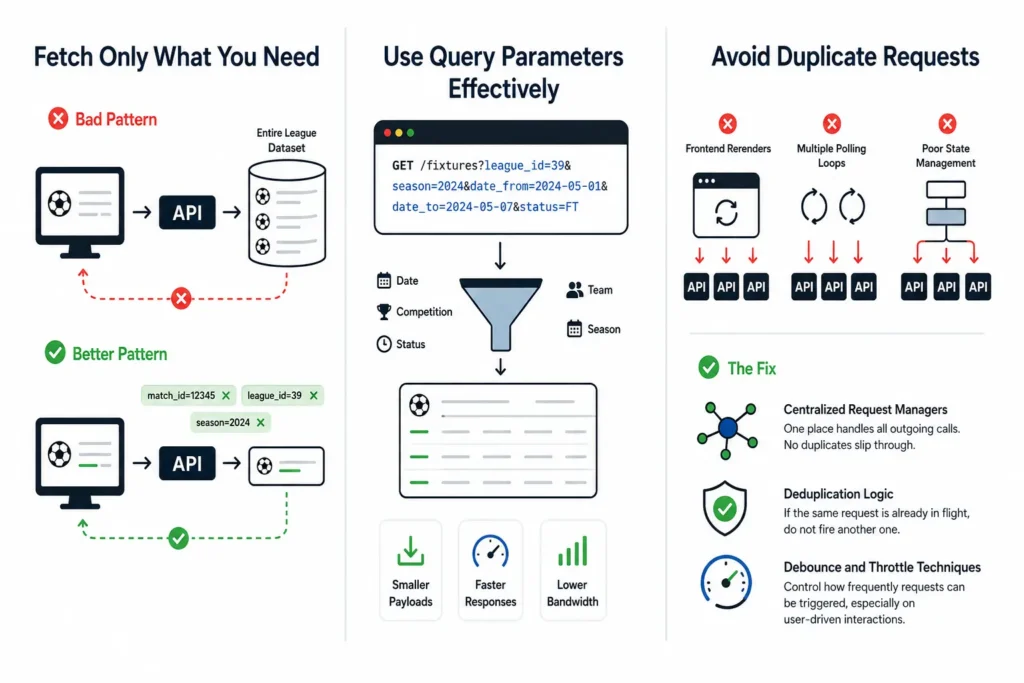
Fetch Only What You Need
Only pull the data you actually use. Fetching entire datasets when you need a slice of them is just burning API calls for nothing.
- Bad Pattern — Requesting entire league datasets repeatedly, even when only one match is relevant.
- Better Pattern — Use scoped endpoints. Request by match, by league, by date, or by season. Get exactly what you need, nothing more.
Use Query Parameters Effectively
Query filters are one of the simplest tools available and one of the most underused. Filtering by date, team, competition, status, or season means smaller payloads, faster responses, and lower bandwidth usage. Less data traveling means less strain on everything.
Avoid Duplicate Requests
Sending the same request twice is just waste. It happens more than you think — frontend rerenders triggering redundant calls, multiple polling loops running in parallel, poor state management pulling the same data over and over.
The fix is straightforward:
- Centralized request managers — One place handles all outgoing calls. No duplicates slip through.
- Deduplication logic — If the same request is already in flight, do not fire another one.
- Debounce and throttle techniques — Control how frequently requests can be triggered, especially on user-driven interactions.
What Caching Strategies Work Best for Football API Optimization?
Caching is the technique of storing football data locally after the first API fetch — so when the next request comes in, the app serves it directly without making another call to the API. During live matches, this matters more than anywhere else. Hundreds of users requesting the same score update at the same time. Instead of firing a separate API call for each one, the app caches the data on the first hit and handles every user from its own database. Lower latency. Reduced API costs. Fewer rate-limit issues.
For football API for developers, getting caching right is one of the highest-leverage moves you can make.
Types of Football Data Suitable for Caching

Not all data ages the same way. Cache accordingly.
- Long Cache Duration — Team logos, historical stats, player profiles. This data rarely changes. Cache it hard and forget about it.
- Medium Cache Duration — Standings, fixtures, squad data. Updates happen but not in real time. Refresh on a reasonable schedule.
- Short Cache Duration — Live scores, in-play statistics, betting odds. This data moves fast. Cache it briefly, refresh it often.
Recommended Cache Layers
- CDN Caching — Best for static assets and media. Delivers content from the edge, closest to the user.
- Server-Side Caching — Redis and Memcached are the go-to tools here. Fast, reliable, and built for high-frequency reads.
- Database-Level Caching — Query optimization ensures your database is not doing redundant heavy lifting on every request.
- Frontend Caching — Browser cache and service workers keep frequently used data available without hitting the server at all.
Here’s a guide on handling football API rate limits in a more efficient way.
How Do You Optimize Polling Frequency for a Football Live Score API?
Polling keeps your application up to date. Aggressive polling keeps your API bill climbing. That is the difference. You need to be smart about how often you are making calls — because firing requests every second whether something has changed or not is just waste. It burns through your quota, loads your infrastructure for no reason, and gets you rate limited fast. This is a core principle of football API optimization that every football data feed integration needs to get right.
Recommended Polling Intervals
Match state should drive your polling frequency. Not the other way around.
- Pre-Match — Poll every 60 to 120 seconds. Nothing critical is changing yet. Save your calls for when they matter.
- Live Match — Poll every 5 to 15 seconds. This is where it counts. Fast enough to feel real-time, controlled enough to stay within limits.
- Half-Time — Slow it down. The action has paused. Your polling should too.
- Post-Match — Stop polling. The data is final. There is nothing left to fetch.
Adaptive Polling
Static intervals only get you so far. Adaptive polling takes it further by adjusting dynamically based on what is actually happening in the match.
- Dynamic refresh intervals — Your polling rate shifts automatically depending on match state, not a fixed timer.
- Event-driven updates — A goal, a red card, a substitution — high-impact moments trigger an immediate refresh rather than waiting for the next interval.
- Match-state awareness — The system knows when the game is live, paused, or finished and behaves accordingly.
The smartest polling strategy is one that mirrors the match itself. Fast when it matters. Quiet when it does not.
How Should Football API Developers Handle Rate Limits?
Your football API provider plan comes with rate limits. It could be a cap on requests per minute, per day, or per month — depending on what you are subscribed to. Hit that limit and your app stops getting data. That is not a technical inconvenience. That is your platform going dark mid-match.
Rate limits come in a few forms — requests per minute, requests per day, and concurrent connection limits. Know which ones apply to your plan before you build around them. This is especially important for football API for startups and football API for developers working within tight usage tiers.
Best Practices

- Queue Requests — Do not let traffic spikes fire hundreds of calls at once. A request queue controls the flow and prevents you from blowing through your limit in a burst.
- Retry With Backoff — When a request fails, do not immediately retry. Use an exponential backoff strategy — wait a little, then a little more. It reduces pressure on the API and improves your chances of a clean retry.
- Prioritize Critical Endpoints — Not all data is equal. Live scores come before historical stats. When calls are limited, the real-time feed gets priority.
The best practice above all is continuous monitoring. Track your usage, spot the patterns, and find where calls are being wasted before the limit finds you first.
When Should You Use WebSockets Over REST for a Football Data Feed?
WebSockets is your best tool for real-time football data. A WebSocket is an open connection between your application and the server. The moment something happens — a goal, a red card, a substitution — the data gets pushed to you instantly. No request needed. No waiting for the next polling interval. You get notified as it happens.
Compare that to REST polling, where your app is constantly asking whether anything changed. WebSocket streaming flips that. The server talks to you when it has something to say. For any football data feed that needs to feel truly live, WebSockets is the right call.
Benefits of WebSockets
- Fewer repeated requests — One open connection replaces hundreds of polling calls.
- Lower latency — Data arrives the moment it is available, not on your next scheduled fetch.
- Real-time event delivery — No delays, no stale windows, no missed moments.
Ideal Use Cases
WebSockets work best where real-time accuracy is non-negotiable — football live score API integrations, live commentary, betting odds, and in-game analytics. If your platform touches any of these, WebSockets should be part of your architecture.
Here’s an in-depth guide on WebSockets vs polling for football API, which helps you understand which one works better for use cases.
How Do You Build a Backend Architecture Around Football API Optimization?
A fast API means nothing if your backend cannot keep up. The architecture behind your application is what determines how well it handles load, how cleanly it processes data, and how much it can take before it starts cracking under pressure. Whether you are pulling from a soccer API or a football data provider, the backend is where football API optimization either holds or breaks.
Use an API Gateway Layer
Run everything through a single gateway. It centralizes your caching, handles request validation, enforces rate limiting, and aggregates data from multiple sources in one place. Cleaner architecture. Easier to debug. Easier to scale.
Normalize Football Data
Raw API responses are messy. Different providers name the same fields differently. Inconsistent naming and duplicate records will cause problems downstream if you do not clean them up early. Normalize your data at the point of ingestion so the rest of your application is working with something reliable.
Use Background Jobs
Not everything needs to happen on request. Scheduled sync tasks, prefetching fixtures, standings updates — move these to background jobs. Your live endpoints stay lean and fast. The heavy lifting happens quietly in the background without touching the user experience.
Database Optimization
Your database is only as fast as you build it to be.
- Indexing — Index your most queried fields so lookups stay fast as your data grows.
- Read replicas — Distribute read traffic across replicas so your primary database is not carrying the full load.
- Optimized queries — Slow queries are silent killers. Write lean, targeted queries and audit them regularly.
- Partitioning historical data — Keep current season data separate from historical records. Searching through years of archived matches to find today’s fixture is a performance problem you can avoid entirely.
How Can Football API for Developers Improve Frontend Performance?
Backend optimization only gets you halfway. If your frontend is inefficient, users feel it regardless of how fast your API is responding. Frontend performance is what turns a well-built backend into a well-built product. For football API for developers, this is where the user experience is won or lost.
Lazy Load Data
Do not pull everything at once. Load match details only when a user actually opens them. Less data on initial load means faster renders and a smoother first impression.
Reduce Re-Renders
Every unnecessary re-render is wasted processing. Use memoization to stop components from recalculating when nothing has changed. Keep your state lean and targeted — bloated state management is one of the most common causes of sluggish football apps.
Use Skeleton Loaders
Users tolerate loading. They do not tolerate staring at a blank screen. Skeleton loaders fill the space while data is coming in, giving the impression of speed even before the content arrives. Perceived performance is still performance.
Batch UI Updates
This one matters most for football live score API integrations and dashboards. Do not update the UI on every single incoming data change. Batch those updates and render them in controlled intervals. The experience feels smoother and your browser is not constantly fighting to keep up.
How Do You Monitor and Observe Football API Performance?
Tracking and monitoring your API usage is one of the best things you can do for your platform. You need to study your users, call out patterns, and find the inefficiencies before they become problems. The insights you pull from monitoring are what turn guesswork into rock-solid football API optimization strategies — ones that improve performance and save you money at the same time.
Track Key Metrics
Start with the numbers that actually tell you something.
- Response time — How long your API calls are taking from request to delivery.
- Cache hit ratio — How often data is being served from cache versus hitting the API directly. A low ratio means your caching strategy needs work.
- Failed requests — Where calls are dropping, how often, and why.
- API quota usage — How close you are running to your limits on any given day.
- Request volume — Traffic patterns across match days, off-seasons, and major tournaments.
Use Monitoring Tools
Tools like Grafana, Datadog, Prometheus, and New Relic give you dashboards and historical data to work from. Use them to study user behavior, spot waste, and build football API optimization strategies that hold up over time.
Build Alerting Systems
Do not wait for users to report problems. Build alerts that catch delayed feeds, stale data, and outage conditions the moment they occur. The faster you know, the faster you fix it.
What Are the Security Best Practices for a Football API Provider?
Performance means nothing if your platform is not secure. Whether you are integrating a football data provider or building on top of a soccer API, security should be a priority from day one — not something you patch in after something goes wrong.

Protect Your API Keys
Your API key is the access point to everything. Expose it and you lose control of your quota, your data, and potentially your entire plan. Never expose keys client-side where they can be scraped. Store them in environment variables and keep them server-side where they belong.
Validate Incoming Data
All incoming data should be validated. Every single request. Malformed payloads and injection attacks are not rare edge cases— they are active threats. Validate early, validate strictly, and do not let bad data anywhere near your system.
Implement Request Authentication
Lock down who can talk to your backend. JWT, OAuth, and signed requests are all solid options depending on your architecture. Pick the right one, implement it consistently, and do not leave any endpoints exposed.
What Are the Most Common Football API Optimization Mistakes?
Most football API performance problems are not random. They are the same mistakes showing up in different codebases. Here are the ones worth watching out for.
- Over-Polling Live Data — Firing requests every second because it feels safer. It is not. It is just expensive and unnecessary. Match your polling frequency to what is actually happening on the pitch.
- Fetching Entire Datasets Repeatedly — Pulling full league datasets when you only need one fixture. Lazy by design, costly in practice. Scope your requests and fetch only what you need.
- Ignoring Cache Invalidation — Caching is only useful if stale data gets cleared. Serving outdated scores or wrong standings is worse than serving no data at all.
- No Fallback Strategy During API Downtime — APIs go down. It happens. If your platform has no fallback when it does, your users find out the hard way mid-match.
- Weak Error Handling — Silent failures, no retries, no logging. Problems pile up invisibly until something breaks completely and you have no idea where to start.
- Building Without Scalability Planning — What works for a thousand users falls apart at a hundred thousand. Build with scale in mind from day one, not as an afterthought.
Conclusion
Modern football platforms are powered by football APIs. They are the foundation on which everything is built—football fantasy API products, betting platforms, analytics dashboards, football live score API integrations. None of it functions without a reliable data layer behind it. The API is not just a tool. It is the backbone of the entire product.
Football API optimization is what separates platforms that grow from platforms that struggle. Every subscription with a football API provider comes with limited resources. It is up to you how well you use them. Burn through your calls inefficiently and you are paying extra just to keep the lights on. Optimize smartly and those same resources take you further—faster experiences, lower costs, higher reliability, and a platform built to scale without breaking.
The decisions you make around caching, polling, architecture, and monitoring are not just technical choices. They are business decisions. They determine how your platform performs when it matters most—on match day, at peak traffic, when every second counts.
The best football applications are not the ones making the most API calls. They are the ones making the smartest ones.
FAQ
How often should a football API be polled during a live match?
During a live match, polling every 5 to 15 seconds is the sweet spot. Aggressive enough to feel real-time, controlled enough to stay within your API limits. Outside of live play—pre-match, half-time, post-match—slow it down or stop entirely. Your quota will thank you.
What is the best caching strategy for live football data?
Cache based on how fast the data changes. Static assets and historical data can sit in cache for a long time. Standings and fixtures need a moderate refresh. Live scores, in-play stats, and betting odds need short cache windows with frequent updates. Layer your cache across CDN, server-side tools like Redis, and the frontend for maximum efficiency.
When should WebSockets be used over REST for a football data feed?
Anytime real-time accuracy is non-negotiable. Football live score API integrations, live commentary, betting odds, in-game analytics—these are where WebSockets outperform REST polling. One open connection replacing hundreds of repeated requests means lower latency and a far better experience for the user.
How do you prevent hitting football API rate limits?
Queue your requests to prevent spikes. Use exponential backoff when retries are needed. Prioritize your most critical endpoints—live data before historical. And monitor your usage continuously so you are never caught off guard when the limit is close.
How can football API costs be reduced without compromising performance?
Fetch only what you need. Use query parameters to filter payloads down to exactly the data your platform requires. Cache aggressively so repeat requests never hit the API unnecessarily. Match your polling frequency to actual match state. And eliminate duplicate requests through centralized request management and deduplication logic. Smart football API optimization always costs less than heavy usage.


