entity sport profile-icon
+91 6377026492
sales@entitysport.com sales@entitysport.com

Blog

Exploring the intersection of technology, APIs, and sports data analytics.

Real-Time vs Delayed Football Data? Choosing the Right API for Your Sports Product

May 22, 2026
Real-Time vs Delayed Football Data? Choosing the Right API for Your Sports Product

Football is a game that demands speed. An equalizer in the 90th minute can shift everything — the match, the momentum, the entire narrative. That change happens so fast it is almost hard to fathom. Now imagine a football platform that tells you about it a minute later. Real-time vs delayed football data makes all the difference.

Modern football platforms run on a football API. It is the engine behind every live score update, every stat refresh, every odds movement. But if the API itself is only capable of sending out delayed or sluggish data, it does not align with the nature of the game it is supposed to serve.

Delayed data makes users lose trust. It gives them a genuine reason to go looking for a better football API provider.

Not all football APIs deliver data the same way. Understanding the real-time vs delayed football data debate is essential before building any sports product. For developers and businesses, choosing the wrong type can affect engagement, infrastructure costs, latency, and even legal compliance.

This article breaks down what real-time and delayed football data mean, how they work, the pros and cons of each, their ideal use cases, and how to choose the right solution for your product.

What Is a Football API and How Does It Work?

A football API is a service that allows you to access real-time and historical football data through structured endpoints. Your platform sends a request to the API and receives the specific data you asked for — delivered in JSON format that can be decoded into readable information for your users.

Data can be retrieved in two main ways:

  • REST APIs — Your platform polls the API at set intervals to fetch updated data. Simple to implement, widely supported.
  • WebSocket feeds — A persistent open connection that pushes data to your platform the moment it is available. Built for real-time delivery.

Common data types include:

  • Live scores
  • Fixtures and schedules
  • Player statistics
  • Team standings
  • Lineups
  • Match events
  • Odds
  • Historical data

A football API can power a wide range of products — a football live score API integration, a football fantasy API platform, a FIFA API connection, or a betting odds dashboard. Each has its own use cases and its own variety of users.

But across all of them, the biggest differentiator between football APIs is the speed of data delivery. Some do it fast. Some take their time. That difference changes everything.

Here's an in-depth guide for Football API.

What Is Real-Time Football Data and Why Does Speed Matter?

Real-time football data is match information delivered as it happens — instantly, or with the minimal possible latency. The faster the data arrives, the closer the experience feels to watching the game live. For users, that gap between the real world and the screen is everything.

Examples of real-time events include:

  • Goals
  • Substitutions
  • Yellow and red cards
  • VAR decisions
  • Possession updates
  • Live player stats

How It Works

Real-time data starts at the stadium. Data scouts and on-ground providers capture events as they happen and feed them into ultra-low-latency pipelines. From there, WebSocket or push technologies carry that data to your platform in near-instant time.

How real-time data delivery works
  • Data scouts and providers — Capture live events directly from the stadium.
  • WebSocket technology — Keeps a persistent connection open so data is pushed the moment it is available.
  • Ultra-low-latency pipelines — Built specifically to minimize the time between event and delivery.

Latency expectations for premium real-time APIs typically sit between 1 and 5 seconds. WebSockets bring that number closer to a single second.

Real-time football API providers prioritize speed above everything else. A delayed goal update during a nail-biting match does not just frustrate users — it pulls them out of the moment entirely and gives them a reason to leave.

What Is Delayed Football Data and When Does It Make Sense?

Delayed football data is match information delivered by a football data feed after a fixed gap in time. For static content — player profiles, historical stats, standings — a delay rarely matters. But for live match data, users expect the minimum possible lag. That is what they are on your platform for.

Picture this. A user is live on your app for the full 90 minutes, fully invested in the match. They find out their team scored the winning goal a minute later — from a friend's text, not your platform. That is not just a bad experience. That is a trust problem your platform may not recover from.

Typical delays range from:

  • 30 seconds
  • 1 minute
  • 5 minutes
  • 15 minutes — depending on the provider

Delays exist for a few reasons:

  • Licensing agreements with broadcasters and rights holders
  • Lower infrastructure costs on the provider's end
  • Betting restrictions in certain markets
  • Broadcast rights that prohibit instant data redistribution

Data is usually delivered through:

Delayed football APIs trade speed for affordability. That works for certain products. But for any platform where the live experience is the product, a delayed football data feed quietly bleeds users — and they rarely come back.

What Are the Key Differences in Real-Time vs Delayed Football Data?

Choosing between real-time vs delayed football data is not just a technical decision. It is a product decision. Here is how the two stack up:

FeatureReal-Time DataDelayed Data
Update SpeedInstantFixed delay
InfrastructureComplexSimpler
CostHigherLower
Use CasesBetting, live appsBlogs, stats sites
Delivery MethodWebSocket/streamingREST polling
Server LoadHighModerate
Licensing ComplexityHigherLower
User ExperienceHighly interactiveInformational

Speed and Latency

In live products, milliseconds matter. A betting user acting on a goal that already happened. A fantasy manager whose points have not updated. A fan who already knows the score from somewhere else. Every second of delay is a second your platform is behind reality. Real-time APIs close that gap. Delayed APIs accept it.

Infrastructure Requirements

Real-time systems require scalable servers that absorb match-day traffic spikes, streaming architecture that keeps data flowing, and event processing pipelines that handle high-frequency updates without dropping anything. It is a heavier build — and a heavier operational responsibility.

Cost Considerations

Premium real-time football data feeds cost significantly more than delayed alternatives. The infrastructure, the licensing, the latency optimization — all of it is priced in. For startups and smaller products, that cost gap alone can determine which route makes sense.

Data Accuracy and Reliability

Real-time systems move fast, and speed introduces risk. Events can occasionally arrive out of order, duplicate updates can slip through, and corrections sometimes follow the original data. A well-built integration handles these edge cases gracefully. A poorly built one surfaces them directly to users.

Here's a guide on why data accuracy matters in Football.

Which Products Benefit Most from Real-Time vs Delayed Football Data?

Which products benefit from real-time data?

Sports Odds Platforms

Odds platforms are where real-time data matters the most. The stakes are high and the margins are thin. A single second of delay can mean a user places a bet on odds that have already shifted. In-play odds, instant odds updates, and live trading systems all depend on data that moves as fast as the game does. Delay is not an inconvenience here — it is a liability.

Football Fantasy Apps

A football fantasy API platform is another space where real-time data is non-negotiable. Users are watching live, tracking their players, checking their rankings mid-match. Delayed point updates and stale leaderboards push users toward faster platforms. In a competitive market, speed is a retention strategy.

Live Score Applications

A football live score API integration runs entirely on real-time data. Fans want to be notified the moment something happens on the pitch — a goal, a red card, a substitution. Any delay breaks the core promise of the product.

Media Broadcasters

Broadcasters and sports news channels use football data feeds to power live graphics, on-screen stats, and second-screen experiences. Real-time data with minimal latency keeps them ahead of competitors pulling from the same matches.

AI and Predictive Analytics

AI models are only as good as the data feeding them. Real-time football data powers win probability models, expected goals calculations, and momentum tracking — all of which lose their value the moment the data goes stale.

The faster the engagement cycle, the more valuable real-time data becomes. Live football is not a passive experience. Users are reacting, betting, managing, and competing. Speed is what keeps them in the game.

When Should You Choose a Delayed Football Data Feed Over Real-Time?

When to choose delayed football data

Sports Blogs and Editorial Websites

For sports blogs and editorial websites, a slight delay does not compromise quality. Match reports, post-game analysis, and fixture previews do not require second-by-second accuracy. Delayed data works perfectly fine here.

Historical Statistics Platforms

Historical data does not need real-time speed. A player's past performance or a team's head-to-head history is not going to change mid-match. Delayed APIs are more than sufficient for platforms built around stats and historical analysis.

Small Startups and MVPs

At the early stage, cost efficiency matters more than cutting-edge latency. Delayed football APIs — whether from a FIFA API or any other football data provider — help startups reduce infrastructure costs, lower backend complexity, and ease scaling pressure while the product finds its footing.

Educational and Hobby Projects

Student developers, portfolio apps, and personal football dashboards do not need premium real-time feeds. Delayed APIs give builders access to rich football data without the overhead of a live data infrastructure.

SEO-Focused Sports Websites

Content-driven sports websites rely on fixtures, standings, and post-match statistics — not second-by-second updates. Delayed data is well-suited for pages built around search traffic rather than live engagement.

A delayed football data feed is not a lesser choice. For platforms where live speed is not part of the product promise, it is often the smarter one.

What Are the Biggest Challenges of Real-Time vs Delayed Football Data?

Real-time football data comes at a price — and not just financially. Before committing to a live feed, it is worth understanding exactly what you are signing up for.

Infrastructure Costs

Minimal latency requires serious infrastructure. The faster the data needs to move, the more it costs to move it reliably.

  • Scalable architecture that absorbs match-day traffic spikes
  • Event streaming pipelines that keep data flowing without interruption
  • Low-latency caching layers that serve data without hitting the source every time

WebSocket Complexity

WebSockets are the backbone of real-time delivery, but they are not simple to manage.

  • Persistent connections need to be maintained across thousands of concurrent users
  • Reconnection handling has to be bulletproof — a dropped connection during a live match is not acceptable
  • Concurrency at scale adds a layer of complexity most teams underestimate

Here's a guide that explains the difference between WebSockets and REST polling for football APIs.

Data Consistency

Real-time systems move fast, and speed introduces risk.

  • Duplicate events slip through
  • Corrections follow original updates
  • Data occasionally arrives out of order

A robust integration handles these gracefully. One that does not surfaces the mess directly to users.

Licensing and Rights

Premium live sports data does not come without strings attached.

  • Strict contracts with data providers
  • Redistribution limitations depending on your product type
  • Geographic restrictions that vary by market

Operational Pressure

Downtime during a live match is not a minor inconvenience — it is a product failure. Real-time systems demand near-perfect uptime at exactly the moments when traffic is highest and pressure is greatest.

These challenges are real. They are also why many businesses deliberately choose delayed feeds — not because they cannot handle real-time, but because they have done the math and decided they do not need to.

How Do You Choose the Right Football API Provider for Your Product?

Choosing the right football data provider requires critical thinking. The wrong choice costs you users, money, and time. Answer these questions honestly before committing.

1. What Is Your Product Type?

  • Odds app
  • Fan app
  • Editorial platform
  • Analytics tool

Your product type determines everything else. Know what you are building before you evaluate speed.

2. How Important Is Speed?

  • Do your users need instant updates the moment something happens on the pitch?
  • Or are periodic refreshes enough to serve the experience you are building?

The answer to this question alone narrows down your options significantly.

3. What Is Your Budget?

  • Real-time feeds cost more — sometimes significantly more
  • Your budget defines the realistic ceiling on data speed your platform can afford
  • Be honest about what your current stage can support without overextending

4. What Is Your Technical Capability?

  • Can your team handle WebSocket connections at scale?
  • Do you have the infrastructure for stream processing?
  • Can you manage and maintain a scaling architecture under live match load?

5. Are There Licensing Concerns?

  • Betting platforms, broadcasters, and products built around commercial redistribution need to understand the legal boundaries of any data agreement before signing

Recommendation Framework

Choose real-time data if:

  • Your product depends on live engagement
  • Users expect instant updates
  • Your monetization model depends on speed

Choose delayed data if:

  • Your content is informational rather than live
  • Cost efficiency matters more than latency
  • You are building an MVP or an SEO-driven product

The right football API provider is not the fastest one or the cheapest one. It is the one that fits where your product is today and where it is going tomorrow.

Here's a guide to help you choose the right Football API provider.

Is a Hybrid Real-Time vs Delayed Football Data Model Right for You?

The hybrid approach means using both real-time and delayed data within the same platform — but dividing them by use case. Real-time data handles everything that needs to move fast. Delayed data handles everything that does not.

For example, live match events — goals, penalties, corners, cards — are delivered through real-time feeds or WebSocket connections. Historical stats, advanced analytics, and post-match data that do not influence the live experience are accessed through delayed outputs. Same platform, two data speeds, each used where it makes sense.

Many platforms combine:

  • Delayed public data for general content
  • Selective real-time premium feeds for live features

Benefits:

  • Reduced infrastructure and API costs
  • Scalable monetization — charge users for real-time access
  • Better control over what your backend needs to handle at any given time

Freemium strategies built around this model are becoming common — delayed data on free plans, real-time feeds unlocked on premium tiers. Some football data providers, including those offering FIFA API access, structure their entire pricing around this split.

It is a smart way to build. You get the speed where it matters and the savings where it does not.

Conclusion

The difference between real-time vs delayed football data is not just about speed. It has a more strategic edge to it. The real differentiator is the use case — what your platform does, who it serves, and what it promises its users.

Real-time APIs maximize engagement and interactivity. Delayed APIs offer affordability and operational simplicity. Neither is universally better. Both have a place in the market.

The best football API for your product depends on your audience, your business model, your infrastructure, and your product goals. Get those four things clear and the choice becomes obvious.

  • Evaluate your latency needs carefully before committing to a provider
  • Test API reliability under real match conditions, not just sandbox environments
  • Choose a football data provider aligned with your long-term scalability — not just your current stage

The right data at the right speed is what separates platforms users trust from platforms they abandon.

FAQ

What is the difference between real-time and delayed football data?

Real-time football data is delivered instantly or with minimal latency — typically within 1 to 5 seconds of an event occurring on the pitch. Delayed data is distributed after a fixed gap, anywhere from 30 seconds to 15 minutes depending on the provider. In the real-time vs delayed football data debate, the difference is not just speed — it is the entire user experience that follows from it.

Which type of football API is better for a betting platform?

Real-time data is non-negotiable for betting platforms. In-play odds, live trading systems, and instant odds updates all depend on data that moves as fast as the match does. A delayed football data feed in a betting context is not just a bad experience — it is a liability.

Can a small startup afford a real-time football API?

It depends on the provider and the plan. Many football fantasy API and live score platforms start on delayed tiers and upgrade as they scale. For startups in the early stage, a delayed API is often the smarter starting point — lower cost, lower complexity, and enough data to build and validate the product before scaling up.

What is a hybrid football API model?

A hybrid model combines real-time and delayed data within the same platform, dividing them by use case. Live match events like goals, cards, and substitutions are delivered in real time. Data that does not influence the live experience — historical stats, advanced analytics — is accessed through delayed feeds. It reduces costs while keeping the live experience intact.

How do I choose the right football API provider for my product?

Start by getting clear on four things — your product type, how important speed is to your users, your budget, and your team's technical capability. A betting app and a sports blog have completely different requirements. The right football data provider is not the fastest or the cheapest — it is the one that fits your product today and scales with it tomorrow.

read more >

Football API Optimization: API Calls and Building Faster, Smarter, and More Reliable Sports Applications

May 21, 2026
Football API Optimization: API Calls and Building Faster, Smarter, and More Reliable Sports Applications

Football has been on the rise since it first became a game. Hundreds of championships each year. A FIFA World Cup every four years. Thousands of players fighting to make their team the best. This did not happen overnight. And neither did the rise of real-time football applications. Today, most of these platforms run on a football API. The API is the backbone. It is what feeds live scores, match events, player stats, and standings into the product in real time. Whether you are building a football live score API integration, a football fantasy API platform, or an odds product, how fast and accurately your football API optimization strategy delivers that data is what defines performance.

Choosing an inefficient football API provider does not just slow things down. It costs you. Delayed live scores. Laggy fantasy apps. Stale betting odds. Overloaded backend systems. The damage shows up everywhere.

This guide covers how to avoid that. We are talking performance, reliability, scaling, caching, polling strategies, and architecture optimization—everything you need to build a football application that does not break when it matters most.

Why Does Football API Optimization Matter for Your Platform?

Football API optimization is not just a technical checkbox. It helps your platform function more efficiently and cuts down costs — opening the door for real scalability. Whether you are a football data provider, a startup, or an established product, the same rules apply.

Here's a detailed guide on Football API.

User Expectations Have Changed

  • Football fans have set the bar way too high. They want real-time data with zero compromise on accuracy.
  • The moment something happens on the pitch, they expect to know. That creates a real challenge — deliver fast, stay accurate, and still beat the competition doing the same thing.

Performance Directly Impacts Product Quality

  • A football app that delivers instant updates is the one fans keep coming back to.
  • A slow API loses trust fast. There is no point delivering data a minute after the fact. Nobody likes spoilers. It does not just frustrate users — it pushes them straight to a better option.

Here's a guide on why football API data accuracy matters and how it impacts the performance of your platform.

API Costs Scale Quickly

  • APIs are not cheap to run wrong. Most subscription models from any football API provider cap you on requests — monthly, daily, or hourly.
  • Overfetching, short polling intervals, redundant requests — all of it adds up. Hit the limit and you are paying extra just to keep the lights on.

Football API Optimization Improves:

  • Latency — Faster data delivery means your users see updates the moment they happen, not after.
  • Infrastructure stability — A well-optimized app does not crack under pressure. It holds up when match day traffic spikes.
  • Mobile performance — Most fans are on their phones. A lighter, faster API call keeps the experience smooth regardless of network conditions.
  • Server efficiency — Fewer unnecessary requests means your servers are not working overtime for no reason.
  • Scalability — When your platform grows, football API optimization is what keeps it from falling apart at the seams.

What Are the Most Common Football API Request Patterns?

Not all users request the same data. Request frequency shifts constantly—and during live matches, it spikes hard. Understanding these patterns is the first step to building something that can actually handle them. This applies whether you are working with a soccer API, a football data feed, or a dedicated football live score API.

Common Football API Workloads

Common football API request patterns
  • Live Match Requests — Traffic surges the moment a match kicks off. Every user is hitting the API at the same time, pulling the same real-time data. High-frequency updates. Most resource-intensive workload you will deal with.
  • Fixture & Schedule Requests — Lower frequency, lower pressure. This data does not change every few seconds, which makes it one of the easiest to cache and serve efficiently.
  • Team & Player Statistics — Medium-frequency requests. Updated regularly but not in real time, so there is room to be smart about how often you fetch them.
  • Odds & Betting Data — Requires aggressive refresh intervals. Stale odds are not just bad UX — they are a liability.

Typical API Architecture Flow

Most football applications follow this path:

Client → Backend → Football API → Database → Frontend

  • Request Handling — Your backend needs to manage how many requests hit the API at once without choking.
  • Transformation Layers — Raw API data rarely goes straight to the frontend. It gets cleaned, formatted, and shaped before it is useful.
  • Caching Opportunities — Not every piece of data needs a fresh API call. Caching saves your request quota for data that actually changes.

How Can Football API Optimization Help Reduce Unnecessary Calls?

Every API call costs you — in quota, in money, and in performance. Reducing unnecessary requests is one of the fastest ways to extend your limits, cut overhead, and set your platform up for scale. This is especially critical for football API for startups operating on tight request budgets. Here is how to do it.

Best practices for efficient API usage

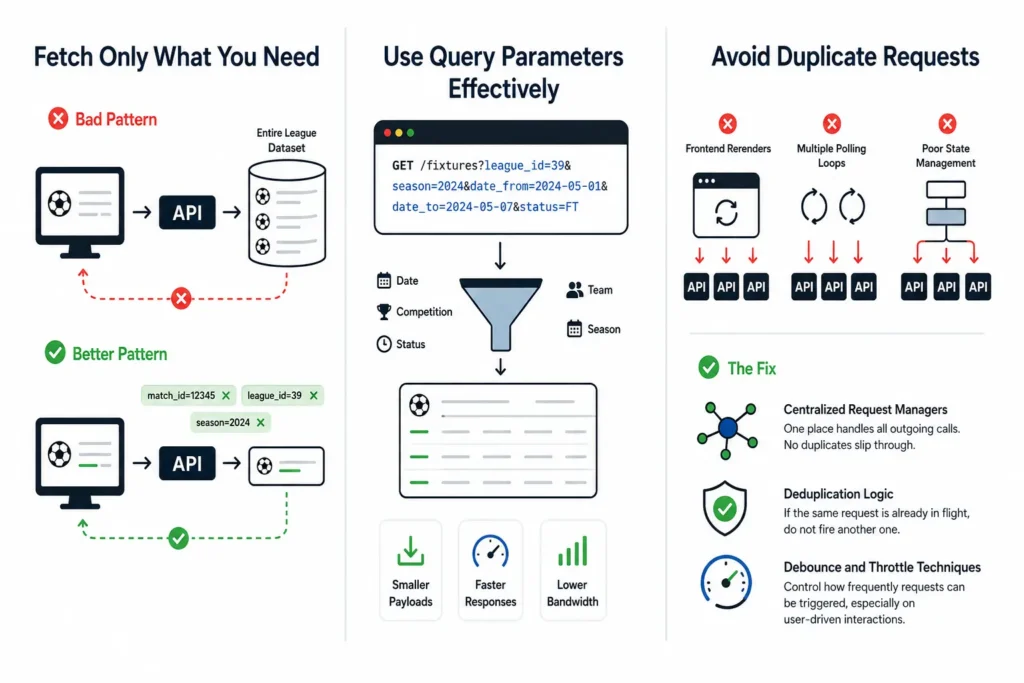
Fetch Only What You Need

Only pull the data you actually use. Fetching entire datasets when you need a slice of them is just burning API calls for nothing.

  • Bad Pattern — Requesting entire league datasets repeatedly, even when only one match is relevant.
  • Better Pattern — Use scoped endpoints. Request by match, by league, by date, or by season. Get exactly what you need, nothing more.

Use Query Parameters Effectively

Query filters are one of the simplest tools available and one of the most underused. Filtering by date, team, competition, status, or season means smaller payloads, faster responses, and lower bandwidth usage. Less data traveling means less strain on everything.

Avoid Duplicate Requests

Sending the same request twice is just waste. It happens more than you think — frontend rerenders triggering redundant calls, multiple polling loops running in parallel, poor state management pulling the same data over and over.

The fix is straightforward:

  • Centralized request managers — One place handles all outgoing calls. No duplicates slip through.
  • Deduplication logic — If the same request is already in flight, do not fire another one.
  • Debounce and throttle techniques — Control how frequently requests can be triggered, especially on user-driven interactions.

What Caching Strategies Work Best for Football API Optimization?

Caching is the technique of storing football data locally after the first API fetch — so when the next request comes in, the app serves it directly without making another call to the API. During live matches, this matters more than anywhere else. Hundreds of users requesting the same score update at the same time. Instead of firing a separate API call for each one, the app caches the data on the first hit and handles every user from its own database. Lower latency. Reduced API costs. Fewer rate-limit issues.

For football API for developers, getting caching right is one of the highest-leverage moves you can make.

Types of Football Data Suitable for Caching

Caching football data

Not all data ages the same way. Cache accordingly.

  • Long Cache Duration — Team logos, historical stats, player profiles. This data rarely changes. Cache it hard and forget about it.
  • Medium Cache Duration — Standings, fixtures, squad data. Updates happen but not in real time. Refresh on a reasonable schedule.
  • Short Cache Duration — Live scores, in-play statistics, betting odds. This data moves fast. Cache it briefly, refresh it often.

Recommended Cache Layers

  • CDN Caching — Best for static assets and media. Delivers content from the edge, closest to the user.
  • Server-Side Caching — Redis and Memcached are the go-to tools here. Fast, reliable, and built for high-frequency reads.
  • Database-Level Caching — Query optimization ensures your database is not doing redundant heavy lifting on every request.
  • Frontend Caching — Browser cache and service workers keep frequently used data available without hitting the server at all.

Here's a guide on handling football API rate limits in a more efficient way.

How Do You Optimize Polling Frequency for a Football Live Score API?

Polling keeps your application up to date. Aggressive polling keeps your API bill climbing. That is the difference. You need to be smart about how often you are making calls — because firing requests every second whether something has changed or not is just waste. It burns through your quota, loads your infrastructure for no reason, and gets you rate limited fast. This is a core principle of football API optimization that every football data feed integration needs to get right.

Recommended Polling Intervals

Match state should drive your polling frequency. Not the other way around.

  • Pre-Match — Poll every 60 to 120 seconds. Nothing critical is changing yet. Save your calls for when they matter.
  • Live Match — Poll every 5 to 15 seconds. This is where it counts. Fast enough to feel real-time, controlled enough to stay within limits.
  • Half-Time — Slow it down. The action has paused. Your polling should too.
  • Post-Match — Stop polling. The data is final. There is nothing left to fetch.

Adaptive Polling

Static intervals only get you so far. Adaptive polling takes it further by adjusting dynamically based on what is actually happening in the match.

  • Dynamic refresh intervals — Your polling rate shifts automatically depending on match state, not a fixed timer.
  • Event-driven updates — A goal, a red card, a substitution — high-impact moments trigger an immediate refresh rather than waiting for the next interval.
  • Match-state awareness — The system knows when the game is live, paused, or finished and behaves accordingly.

The smartest polling strategy is one that mirrors the match itself. Fast when it matters. Quiet when it does not.

How Should Football API Developers Handle Rate Limits?

Your football API provider plan comes with rate limits. It could be a cap on requests per minute, per day, or per month — depending on what you are subscribed to. Hit that limit and your app stops getting data. That is not a technical inconvenience. That is your platform going dark mid-match.

Rate limits come in a few forms — requests per minute, requests per day, and concurrent connection limits. Know which ones apply to your plan before you build around them. This is especially important for football API for startups and football API for developers working within tight usage tiers.

Best Practices

Best practices for Football API usage
  • Queue Requests — Do not let traffic spikes fire hundreds of calls at once. A request queue controls the flow and prevents you from blowing through your limit in a burst.
  • Retry With Backoff — When a request fails, do not immediately retry. Use an exponential backoff strategy — wait a little, then a little more. It reduces pressure on the API and improves your chances of a clean retry.
  • Prioritize Critical Endpoints — Not all data is equal. Live scores come before historical stats. When calls are limited, the real-time feed gets priority.

The best practice above all is continuous monitoring. Track your usage, spot the patterns, and find where calls are being wasted before the limit finds you first.

When Should You Use WebSockets Over REST for a Football Data Feed?

WebSockets is your best tool for real-time football data. A WebSocket is an open connection between your application and the server. The moment something happens — a goal, a red card, a substitution — the data gets pushed to you instantly. No request needed. No waiting for the next polling interval. You get notified as it happens.

Compare that to REST polling, where your app is constantly asking whether anything changed. WebSocket streaming flips that. The server talks to you when it has something to say. For any football data feed that needs to feel truly live, WebSockets is the right call.

Benefits of WebSockets

  • Fewer repeated requests — One open connection replaces hundreds of polling calls.
  • Lower latency — Data arrives the moment it is available, not on your next scheduled fetch.
  • Real-time event delivery — No delays, no stale windows, no missed moments.

Ideal Use Cases

WebSockets work best where real-time accuracy is non-negotiable — football live score API integrations, live commentary, betting odds, and in-game analytics. If your platform touches any of these, WebSockets should be part of your architecture.

Here's an in-depth guide on WebSockets vs polling for football API, which helps you understand which one works better for use cases.

How Do You Build a Backend Architecture Around Football API Optimization?

A fast API means nothing if your backend cannot keep up. The architecture behind your application is what determines how well it handles load, how cleanly it processes data, and how much it can take before it starts cracking under pressure. Whether you are pulling from a soccer API or a football data provider, the backend is where football API optimization either holds or breaks.

Use an API Gateway Layer

Run everything through a single gateway. It centralizes your caching, handles request validation, enforces rate limiting, and aggregates data from multiple sources in one place. Cleaner architecture. Easier to debug. Easier to scale.

Normalize Football Data

Raw API responses are messy. Different providers name the same fields differently. Inconsistent naming and duplicate records will cause problems downstream if you do not clean them up early. Normalize your data at the point of ingestion so the rest of your application is working with something reliable.

Use Background Jobs

Not everything needs to happen on request. Scheduled sync tasks, prefetching fixtures, standings updates — move these to background jobs. Your live endpoints stay lean and fast. The heavy lifting happens quietly in the background without touching the user experience.

Database Optimization

Your database is only as fast as you build it to be.

  • Indexing — Index your most queried fields so lookups stay fast as your data grows.
  • Read replicas — Distribute read traffic across replicas so your primary database is not carrying the full load.
  • Optimized queries — Slow queries are silent killers. Write lean, targeted queries and audit them regularly.
  • Partitioning historical data — Keep current season data separate from historical records. Searching through years of archived matches to find today's fixture is a performance problem you can avoid entirely.

How Can Football API for Developers Improve Frontend Performance?

Backend optimization only gets you halfway. If your frontend is inefficient, users feel it regardless of how fast your API is responding. Frontend performance is what turns a well-built backend into a well-built product. For football API for developers, this is where the user experience is won or lost.

Lazy Load Data

Do not pull everything at once. Load match details only when a user actually opens them. Less data on initial load means faster renders and a smoother first impression.

Reduce Re-Renders

Every unnecessary re-render is wasted processing. Use memoization to stop components from recalculating when nothing has changed. Keep your state lean and targeted — bloated state management is one of the most common causes of sluggish football apps.

Use Skeleton Loaders

Users tolerate loading. They do not tolerate staring at a blank screen. Skeleton loaders fill the space while data is coming in, giving the impression of speed even before the content arrives. Perceived performance is still performance.

Batch UI Updates

This one matters most for football live score API integrations and dashboards. Do not update the UI on every single incoming data change. Batch those updates and render them in controlled intervals. The experience feels smoother and your browser is not constantly fighting to keep up.

How Do You Monitor and Observe Football API Performance?

Tracking and monitoring your API usage is one of the best things you can do for your platform. You need to study your users, call out patterns, and find the inefficiencies before they become problems. The insights you pull from monitoring are what turn guesswork into rock-solid football API optimization strategies — ones that improve performance and save you money at the same time.

Track Key Metrics

Start with the numbers that actually tell you something.

  • Response time — How long your API calls are taking from request to delivery.
  • Cache hit ratio — How often data is being served from cache versus hitting the API directly. A low ratio means your caching strategy needs work.
  • Failed requests — Where calls are dropping, how often, and why.
  • API quota usage — How close you are running to your limits on any given day.
  • Request volume — Traffic patterns across match days, off-seasons, and major tournaments.

Use Monitoring Tools

Tools like Grafana, Datadog, Prometheus, and New Relic give you dashboards and historical data to work from. Use them to study user behavior, spot waste, and build football API optimization strategies that hold up over time.

Build Alerting Systems

Do not wait for users to report problems. Build alerts that catch delayed feeds, stale data, and outage conditions the moment they occur. The faster you know, the faster you fix it.

What Are the Security Best Practices for a Football API Provider?

Performance means nothing if your platform is not secure. Whether you are integrating a football data provider or building on top of a soccer API, security should be a priority from day one — not something you patch in after something goes wrong.

Security best practices for API protection

Protect Your API Keys

Your API key is the access point to everything. Expose it and you lose control of your quota, your data, and potentially your entire plan. Never expose keys client-side where they can be scraped. Store them in environment variables and keep them server-side where they belong.

Validate Incoming Data

All incoming data should be validated. Every single request. Malformed payloads and injection attacks are not rare edge cases— they are active threats. Validate early, validate strictly, and do not let bad data anywhere near your system.

Implement Request Authentication

Lock down who can talk to your backend. JWT, OAuth, and signed requests are all solid options depending on your architecture. Pick the right one, implement it consistently, and do not leave any endpoints exposed.

What Are the Most Common Football API Optimization Mistakes?

Most football API performance problems are not random. They are the same mistakes showing up in different codebases. Here are the ones worth watching out for.

  • Over-Polling Live Data — Firing requests every second because it feels safer. It is not. It is just expensive and unnecessary. Match your polling frequency to what is actually happening on the pitch.
  • Fetching Entire Datasets Repeatedly — Pulling full league datasets when you only need one fixture. Lazy by design, costly in practice. Scope your requests and fetch only what you need.
  • Ignoring Cache Invalidation — Caching is only useful if stale data gets cleared. Serving outdated scores or wrong standings is worse than serving no data at all.
  • No Fallback Strategy During API Downtime — APIs go down. It happens. If your platform has no fallback when it does, your users find out the hard way mid-match.
  • Weak Error Handling — Silent failures, no retries, no logging. Problems pile up invisibly until something breaks completely and you have no idea where to start.
  • Building Without Scalability Planning — What works for a thousand users falls apart at a hundred thousand. Build with scale in mind from day one, not as an afterthought.

Conclusion

Modern football platforms are powered by football APIs. They are the foundation on which everything is built—football fantasy API products, betting platforms, analytics dashboards, football live score API integrations. None of it functions without a reliable data layer behind it. The API is not just a tool. It is the backbone of the entire product.

Football API optimization is what separates platforms that grow from platforms that struggle. Every subscription with a football API provider comes with limited resources. It is up to you how well you use them. Burn through your calls inefficiently and you are paying extra just to keep the lights on. Optimize smartly and those same resources take you further—faster experiences, lower costs, higher reliability, and a platform built to scale without breaking.

The decisions you make around caching, polling, architecture, and monitoring are not just technical choices. They are business decisions. They determine how your platform performs when it matters most—on match day, at peak traffic, when every second counts.

The best football applications are not the ones making the most API calls. They are the ones making the smartest ones.

FAQ

How often should a football API be polled during a live match?

During a live match, polling every 5 to 15 seconds is the sweet spot. Aggressive enough to feel real-time, controlled enough to stay within your API limits. Outside of live play—pre-match, half-time, post-match—slow it down or stop entirely. Your quota will thank you.

What is the best caching strategy for live football data?

Cache based on how fast the data changes. Static assets and historical data can sit in cache for a long time. Standings and fixtures need a moderate refresh. Live scores, in-play stats, and betting odds need short cache windows with frequent updates. Layer your cache across CDN, server-side tools like Redis, and the frontend for maximum efficiency.

When should WebSockets be used over REST for a football data feed?

Anytime real-time accuracy is non-negotiable. Football live score API integrations, live commentary, betting odds, in-game analytics—these are where WebSockets outperform REST polling. One open connection replacing hundreds of repeated requests means lower latency and a far better experience for the user.

How do you prevent hitting football API rate limits?

Queue your requests to prevent spikes. Use exponential backoff when retries are needed. Prioritize your most critical endpoints—live data before historical. And monitor your usage continuously so you are never caught off guard when the limit is close.

How can football API costs be reduced without compromising performance?

Fetch only what you need. Use query parameters to filter payloads down to exactly the data your platform requires. Cache aggressively so repeat requests never hit the API unnecessarily. Match your polling frequency to actual match state. And eliminate duplicate requests through centralized request management and deduplication logic. Smart football API optimization always costs less than heavy usage.

read more >

Why Football API Data Accuracy Matters?

May 19, 2026
Why Football API Data Accuracy Matters?

Football is a fast-paced game. A pass is made. Then the perfect first touch. And the ball soars and hits the net. All this could happen within a second. And the game is a 90-minute jackpot of such events. It’s fast, but none of it would have made a difference if the ball hadn’t hit the nets. Speed makes it exciting, but accuracy changes the game. The same holds for a football API.

An API for soccer that is fast will get attention, but the one that prioritizes football API data accuracy along with speed will earn the most user retention. This doesn’t change if you switch platforms—fantasy football, football odds, or live score applications. Football API data accuracy establishes the quality of your API and directly impacts everything from user trust to revenue.

Football API Data Accuracy Builds Instant User Trust

In football, a mistake can cost you a lot. Whether it happens on the field or off it. Poor data accuracy leaves users frustrated, and once trust is gone, it rarely comes back.

Your app loses users the moment it shows:

  • The wrong score
  • Incorrect player stats
  • Missing or delayed match events

Users prefer accurate data, and if you fail to provide it, they will quickly switch to trusted platforms like ESPN or SofaScore. In live sports, one wrong update can cost you a user forever. The best football API providers understand that football API data accuracy is the benchmark users judge everything by.

Real-Time Decisions Depend on Accurate Football API Data

Real-Time Decisions Depend on Accurate Football API Data

Modern football has users more engaged than ever. They no longer just watch. They actively participate—building teams, competing in leagues, and making split-second calls based on what your platform tells them.

These engagements include:

Each of these is a decision made under pressure, based entirely on the data your platform surfaces. A wrong stat or a delayed update doesn’t just feel bad—it has real consequences:

  • Poor user decisions
  • Financial losses in odds or fantasy
  • Permanent loss of platform credibility

Football API data accuracy is no longer just a feature. It’s a responsibility.

Live Football API Data Requires Accuracy

There is a specific feeling that sports apps are supposed to create—the feeling of being there. Not reading a recap. Not refreshing a static page. Being there, in the moment, as it happens.

A goal is scored. The crowd erupts. And your app reflects it instantly, with the right scoreline, the right goalscorer, the right minute. When your live football score API gets this right, users don’t even notice—they’re just in it. When it breaks:

  • The update arrives late
  • The goalscorer is wrong
  • The timeline doesn’t match

The illusion is gone. Accuracy is what sustains that immediacy—making users feel like they’re watching the game in real time, not reading a distorted version of it.

Consistency Across All Football API Data Points

Football API data accuracy isn’t just about individual data points being correct. It’s about all of them being correct together, at the same time, telling the same story.

A reliable football data feed doesn’t just deliver data—it delivers consistent data across all match events simultaneously. Everything must align:

  • Scoreline
  • Goal events
  • Player stats
  • Match timelines

If the score reads 2-1 but only one goal event is logged, the data is broken. Not partially. Completely. The user now has two conflicting truths and no way to know which to believe. That inconsistency is more damaging than a single wrong number—it signals that the entire platform can’t be trusted.

Every Feature Depends on Football API Data Accuracy

Football app features depends on Football API Data Accuracy

Your app’s features are only as good as the data underneath them. Every layer of your product draws from the same source:

  • Push notifications (“Goal scored!”)
  • Live commentary
  • AI-powered match insights
  • Real time football score updates
  • Match predictions

If the underlying football data feed is wrong, every feature built on top of it fails. They don’t break independently—they break together. Clean data at the source is the only thing that keeps the whole stack reliable.

Football API Data Accuracy Drives Retention and Monetization

Users return to apps they trust. In sports, where stakes feel immediate and personal, trust is built and broken faster than almost anywhere else.

Accurate data creates a compounding effect:

  • Higher engagement from users who trust what they see
  • Better ad performance from longer session times
  • More subscription conversions from a reliable experience

Poor football API data accuracy has the opposite effect:

  • Silent user churn
  • Negative app store reviews
  • Lost revenue that doesn’t announce itself. It just accumulates.

Data Accuracy in Football API – A Key Differentiator in a Competitive Market

Most football apps work with similar data sources. The options are comparable at a baseline. So the question isn’t who has the data—it’s who delivers it consistently.

Consistency over time separates a platform users recommend from one they abandon. Being known as the most accurate football app shapes how developers pick their API provider and how users choose their go-to app in a crowded market.

Football API Data Accuracy Reduces Engineering Overhead

There’s a practical argument for accuracy that often gets overlooked—one that matters to every developer building on sports data infrastructure.

Clean, accurate data means:

  • Fewer bugs in production
  • Less defensive code to catch bad inputs
  • Simpler backend logic
  • Fewer cascading incidents across features

When the data is reliable, your team spends its time building, not patching. That’s the difference between a platform that keeps improving and one stuck playing catch-up.

Conclusion

Football is a game where a single moment can change everything. The platforms built around it are no different. Speed might be what gets users through the door, but football API data accuracy is what keeps them there—through the full 90 minutes, and through every match after that.

If you’re building a platform like FanFoot, the right API choice defines everything. Whether you’re powering a live football score API, a football fantasy API, a football odds platform, or live football data dashboards—the data underneath defines the experience. Get it right, and everything else has a foundation to stand on.

FAQ

Q: Why is football API data accuracy more important than speed?

Speed gets attention. Accuracy keeps users. A fast football API that shows the wrong score or missing stats will lose users faster than a slightly delayed one that gets everything right. In live scenarios like fantasy selections or in-game betting, one inaccurate data point has real consequences—and accurate data is what builds the trust users return for.

Q: How does poor data accuracy affect a betting platform?

An odds platform runs entirely on live, real-time data. A wrong stat, a missed event, or a delayed update can directly influence odds and user decisions. When accuracy fails, users don’t just leave—they leave with a reason, and they share it. The reputational and financial damage compounds fast.

Q: What should I look for when choosing a football API?

When evaluating football API providers, look for:

  • Consistent alignment across scores, events, and player stats
  • Low-latency delivery on match events
  • Historical accuracy benchmarks, not just uptime stats
  • Transparent data sourcing and update frequency

Q: How does a football data feed impact fantasy football platforms?

On a fantasy platform, every user decision—transfers, captain picks, formation changes—is based on player stats and live match data. If the underlying data delivers incorrect stats or delayed events, users make uninformed decisions. That breaks the core fantasy experience and drives them to platforms that get the data right.

Q: Can inaccurate data hurt app monetization?

Yes, directly. Poor accuracy leads to shorter sessions, which hurts ad revenue. It drives churn, which hurts subscriptions. It generates negative reviews, which hurt organic installs. Accuracy isn’t just a quality metric—it’s a revenue driver.

read more >

How to Build Apps with REST API For Football: A Guide

May 19, 2026
How to Build Apps with REST API For Football: A  Guide

Football is a fast-paced game. The speed is what makes it more thrilling. Every second feels unpredictable. Each shot can change the game, change its track. And this applies to digital platforms as well, where fans eagerly track every move of their favourite player. Modern football apps — live score trackers, fantasy platforms, and detailed analytics tools — are powered by a REST API for football that delivers constantly updated data. Real-time information makes all the difference. It separates reliable football data providers from the rest.

A REST API for football is an interface that lets applications access and exchange football data over the internet using REST principles. Matches, teams, scores, players, leagues — all of it, on demand. REST is the standard for sports data delivery because it is scalable, easy to integrate, cacheable, and developer-friendly.

Why a REST API for Football Is Different

Not all APIs are built equal. Football APIs operate in a uniquely demanding environment. Here is what sets them apart:

  • Data changes every second during a live match
  • Users expect live football score updates in real time
  • The variety of data is enormous: fixtures, results, player stats, standings, odds
  • Traffic spikes dramatically on match days

That combination of speed, volume, and variety is why picking the right football API matters so much. A weak integration breaks the experience completely.

How a REST API for Football Is Structured

How a REST API for Football Is Structured

Understanding the architecture makes integration smoother. Most football REST APIs follow a predictable pattern.

Endpoints and Resources

A REST API for football organises data around resources. Common endpoint families include:

  • Matches: live, scheduled, and finished games
  • Teams: squad details, form, and statistics
  • Competitions: leagues, cups, and international tournaments
  • Standings: points tables and rankings
  • Players: profiles, performance data, and transfers

Each endpoint returns a clean, structured response. You request exactly what you need, nothing more.

Filtering and Authentication

Query parameters let you narrow down the football data feed. Filter by date, league, season, or team. Most providers require an API key for authentication — a simple token passed in the request header. Keep that key secure. Exposing it means anyone can burn through your quota.

Making Your First REST API for Football Call

The flow is simple. You send a request to an endpoint. The football REST API returns a response.

A typical match data response includes:

  • Match status: scheduled, live, or finished
  • Competing teams and their identifiers
  • Current score and score progression by period
  • Kickoff time and venue details

Pagination is standard when fetching large data sets. Most providers return results in pages, and you move through them using an offset or cursor. Always check the limits — exceeding them triggers rate-limit errors that break your app at the worst possible time.

Working with Live Football Score Data

This is where the real challenge lives. A live football score is stale the moment it is fetched. You need a strategy for freshness.

Polling vs. Real-Time Updates

  • Polling: Your app calls the REST API for football at set intervals (every 15 to 30 seconds during a match). Simple to implement. Works everywhere.
  • WebSockets / streaming: The server pushes updates as they happen. Lower latency. More complex setup.

For most apps, polling is the practical starting point. During a live match, poll more aggressively. Outside match windows, slow it down to avoid burning through your rate limit.

Designing Your App Around the Football Data Feed

Before you write a single line of code, think in entities. The data is built around relationships between objects.

  • A Match belongs to a Competition
  • Teams are linked to Matches and Players
  • Events (goals, cards, substitutions) belong to a Match

Decide early: are you fetching data on demand or caching it locally? For static data like team names and logos, cache aggressively. For live scores, always fetch fresh. Caching a 90th-minute result from an hour ago is worse than showing nothing.

Performance and Rate Limits

A slow app loses users fast. A broken app loses them forever. Performance discipline with football data integrations comes down to three habits:

  • Only request the data you actually display
  • Respect the rate limits set by your football data provider
  • Cache static resources aggressively and invalidate them on schedule

On match days, your traffic can spike 10x. Design for it early. Use a CDN layer for cached responses. Queue non-critical requests. Your users will not forgive a frozen scoreboard when a goal goes in.

Advanced Use Cases for a REST API for Football

use cases for REST API

Once the basics are solid, the possibilities open up fast. Here are the use cases where a football REST API really earns its keep:

Fantasy Football API Integrations

Fantasy football API platforms need deep player data: form, fitness, upcoming fixtures, and historical performance. A well-built fantasy football API integration uses player endpoints to power draft tools, captain suggestions, and differential picks. Speed matters here — users make decisions at the last minute.

Here's a guide to building your Football fantasy platform using football API.

Football Odds API for Odds Products

Sportsbooks and tipping platforms rely on a football odds API to display match probabilities and lines. Odds shift constantly, which means your polling frequency during pre-match windows needs to match the pace of the market. Pair odds data with match statistics from the same football data provider for maximum depth.

Performance Analytics Dashboards

Coaches and analysts use data to make tactical decisions. Pass maps, heat maps, pressing stats, and defensive lines — all of it flows through the football data feed. Build endpoints that let analysts slice by match, phase, or opponent.

Popular REST API for Football Options to Explore

Choosing the best football API depends on what you are building. Here is a quick overview:

  • Entity Sports: focused on live data reliability and fantasy-ready endpoints across multiple competitions
  • LSports: wide league coverage, active developer community, well-documented endpoints
  • Sportsradar: strong on detailed statistics and historical football data feed depth

Evaluate each provider against your actual needs. Coverage, uptime, rate limits, and support response time all matter as much as price.

Common Pitfalls When Using a REST API for Football

Most integration problems are avoidable. Watch out for these:

  • Ignoring time zones: match times returned in UTC will confuse users if you display them raw
  • Over-fetching: requesting full match details every 10 seconds when you only need the score
  • No fallback: if your football API goes down, your app should degrade gracefully, not crash
  • Single provider dependency: always have a backup or retry strategy in place
  • Hardcoding league or season IDs: leagues change, seasons roll over, IDs expire

Conclusion

Football apps live and die by their data. A reliable REST API for football is not just a nice-to-have. It is the foundation the entire experience is built on. Get the integration right, respect the rate limits, design around real-time expectations, and your app will hold up when it matters most.

Pick your football data provider carefully. Test under load. And then build something fans actually want to use.

Frequently Asked Questions

1. What is a REST API for football and how does it work?

A REST API for football is an interface that lets developers request football data — like match results, player stats, and standings — over HTTP. You send a request to an endpoint, authenticate with an API key, and receive structured data back. The REST model makes it straightforward to integrate into any platform, from mobile apps to web dashboards.

Here's an in-depth guide on Football API, if you want to understand how it works from scratch.

2. How often should I poll a football REST API during a live match?

During active play, polling every 15 to 30 seconds strikes the right balance between freshness and rate limit usage. In the final minutes of a tight game, you can push closer to 15 seconds. Outside live match windows, drop to every few minutes or shift to on-demand fetching to preserve your quota.

3. What data does a fantasy football API typically provide?

A fantasy football API typically provides player profiles, current form, injury status, upcoming fixtures, historical performance stats, and position data. Advanced providers also offer expected goals (xG) and other advanced metrics that help platforms build smarter selection and scoring tools.

4. How is a football odds API different from a standard football data feed?

A football odds API focuses on match probabilities and betting lines, which update continuously in the lead-up to a match. A standard football data feed covers match facts, stats, and events. Some football data providers offer both in a single integration, which simplifies architecture and reduces vendor management overhead.

5. What should I look for when choosing the best football API for my app?

Prioritise league and competition coverage for your target audience, endpoint documentation quality, uptime guarantees, rate limit generosity, and support responsiveness. For live apps, also test latency on live football score endpoints during an actual match window before committing to a provider.

read more >

10 Mistakes to Avoid When Choosing a Football API

May 6, 2026
10 Mistakes to Avoid When Choosing a Football API

Introduction

The game of football has no room for errors. A small mistake on the field and you may watch the whole game being snatched by the opponent. And just like you cannot afford these mistakes in the game, you cannot afford them while choosing a football API either.

It is always better to know about such issues prior to choosing a football API and starting to build your platform, rather than coming across such issues mid-journey. This article walks you through the common mistakes developers and business owners make while choosing a football data provider. Avoid these, and you are already ahead of most.

10 Common Mistakes to Avoid When Choosing a Football API

1. Ignoring Football API Data Coverage

Coverage is an important aspect to keep in mind while choosing your football data provider. Not every API covers the same leagues. Some just cover the major leagues, some have a more vast coverage option but miss out on junior leagues and women's tournaments, and some do not support international matches outside the selected leagues.

It becomes extremely important to select a soccer data provider that fits your use case and requirements the best.

Here's an in-depth guide for Football API coverage by Entity Sport.

2. Overlooking Football API Rate Limits

Subscribing to an API plan does not mean you can access as much data as you want within your subscription period. Each API plan comes with a rate limit, i.e., the number of API calls a user can make to retrieve the data. Once you run out of calls, you can either buy extra calls for a sum, or your service stops till your plan is renewed.

It is extremely crucial to be aware of the rate limits being provided by the football API and utilise and choose them accordingly and strategically. Caching, which means storing API responses instead of repeated calling, can help you save your rate limit.

3. Not Checking Data Freshness

Live scores in football are what drive users towards a platform. Of course, the other metrics are just as important, but live scores are the main USP that every football API sets its business on. Some APIs have a high latency while updating live scores. This can make a lot of difference when you are building a football live score application.

Always check the latency of your soccer data provider before subscribing to a plan. A WebSocket is preferred for live scores in football as it has ultra-low latency.

4. Poor Football API Documentation Evaluation

Each API comes with a set of documentation that helps you set up the platform. Clear and easy-to-read documentation helps you in a simpler and more optimised manner compared to messy and complicated documentation. Poor documentation can slow you down more than poor data.

Documentation is usually available to access before subscribing to a plan. Always check the documentation of the football API provider before committing to one.

5. Ignoring Football API Pricing Structure

Pricing is a factor that affects every business in every way. A low-cost and high-return budget structure always works well. Each API provider offers different pricing plans, with almost all of them having multiple tiers that differ based on coverage, API calls, and endpoints provided within the plan.

Always check and compare the pricing and call limits of your football API, making sure to compare the top options in the market. A strategic budget helps you save money that can be spent on platform development instead of buying add-on API calls and paying for hidden costs mid-setup.

6. No Fallback Plan

APIs are unstable, just like the game of football. Relying on a single API as the sole source for your football data without a secondary or backup plan can be a risky move. It can cost you more than you assumed.

It is always wise to have a secondary API as a backup and cache data, so that even when your football data provider goes down temporarily, your platform does not.

7. Not Validating Football API Data Consistency

data consistency in football API

Different football APIs structure data differently. Team names, match IDs, player identifiers, and match status labels can all vary from one provider to another. If you switch providers later or consume data from multiple sources, inconsistent formats will create serious backend headaches.

Before locking in on a football API, run it through your actual data pipeline. Check how it handles edge cases: postponed matches, penalty shootouts, match cancellations. Normalise data at the backend layer so your app is insulated from upstream formatting changes. Consistency in your data layer is what keeps your platform stable long-term.

8. Ignoring Authentication Complexity

Not all APIs are equal in how they handle authentication. Some use simple API keys, which are easy to implement and perfectly adequate for most use cases. Others require OAuth flows or rotating tokens, which add complexity that may not be justified for a straightforward live score or fantasy application.

Match the authentication model to your project's actual needs. If you are building a quick MVP or a lean football API integration, a simple API key setup will serve you better than a complex auth system that slows down your development cycle. Overengineering authentication is a real time sink that most developers only recognise in hindsight.

9. Skipping Football API Community Feedback

Developer reviews are underrated when choosing a football API. The experience of people who have already built with a provider tells you things that no product page ever will. Persistent downtime, inaccurate data during major tournaments, unresponsive support — these issues show up in community feedback before they show up in your production logs.

Before committing, check GitHub issues, Reddit threads, and Stack Overflow discussions tied to the API you are evaluating. If a provider has a pattern of complaints around data accuracy or reliability, those complaints are worth taking seriously. The community has already done part of your due diligence.

10. No Testing with Real Scenarios

Everything looks clean in a sandbox. Match day is a different story. High-concurrency traffic, rapid event sequences, VAR decisions, and match suspensions are the kinds of real-world conditions that expose weaknesses in any football API integration.

Do not sign off on a provider based on sample data alone. Test during actual live games. Push the integration through extra time, penalty scenarios, and sudden match status changes. If the API buckles under real conditions, better to know that before you have paying users on the platform than after.

Conclusion

Choosing a football API is a decision that shapes everything your platform is built on. Get it wrong and you are constantly patching problems instead of building features. Get it right and the data layer becomes invisible, quietly doing its job while you focus on growth.

The mistakes above are all avoidable. Most of them come down to not doing enough due diligence before signing up. Check coverage. Test in real conditions. Read the documentation. Understand the rate limits. Have a backup plan.

Entity Sports has spent nearly a decade building football data infrastructure for developers across live score apps, fantasy platforms, and odds tools. If you are looking for a reliable football API that covers all the bases, it is worth putting Entity Sports through its paces before you decide.

Frequently Asked Questions About Choosing a Football API

What is the most common mistake when choosing a football API?

Ignoring data coverage is the most common mistake. Developers often sign up for a plan only to discover mid-build that the API does not cover the leagues or tournaments their platform needs.

How do rate limits affect my football platform?

Rate limits cap how many API calls you can make within a set period. Exceeding them can pause your service or trigger extra charges. Always model your expected request volume against the plan limits before committing.

Why does documentation quality matter for a football API?

Poor documentation slows down integration and increases the chance of errors. Clear, well-maintained documentation means faster setup, fewer bugs, and less time spent deciphering how endpoints behave.

Should I always use WebSockets for live football data?

WebSockets are preferred for live score applications because they push updates in real time with low latency. REST polling works for less time-sensitive use cases, but for live match tracking, WebSockets deliver a noticeably better user experience.

How do I test a football API before going live?

Test during actual live matches, not just with static sample data. Run the integration through edge cases like extra time, match cancellations, and penalty shootouts to confirm the API handles real-world scenarios correctly.

read more >

How to Choose the Right Football API Provider - Complete Guide

May 6, 2026
How to Choose the Right Football API Provider - Complete Guide

Introduction

Football was already a big game, and over the recent years, it has substantially grown in audience and in the form of digital platforms such as fantasy football platforms, football live score apps, odds platforms for football, and analytical dashboards. A football API is the main engine that powers these platforms. Now choosing the right football API provider might be a bigger problem than building the football platform itself. By the end of this guide, you'll have a clearer picture in terms of choosing the most reliable and accurate football data provider for your platforms, giving you the most opportunities to scale and grow.

What is a Football API?

A football API is a RESTful service that enables applications to access and exchange football data through HTTP requests, returning structured responses (typically in JSON format).

Most common data types that can be accessed via the Football API are:

  • Fixtures
  • Live scores
  • Player stats
  • League standings

Entity Sports is a reliable football data provider, having been in the market for almost a decade and a list of trusted organizations associated with it. Entity Sports' different Soccer APIs are used in applications in the form of:

Define Your Use Case Before Picking a Football API Provider

Football API provider use cases

You need to set your priorities straight to start with. Of course, you can build multiple platforms in the future and scale them as you grow. But if you lack the proper team and management for that, it's always better to find your niche and start building around it.

Different niches require different APIs and have different use cases:

  • Live Score Apps: requires real-time updates with minimal latency
  • Analytical Platforms: requires historical data to analyze player forms and team form
  • Fantasy Apps: require detailed player stats and a fantasy points system

Make sure you ask yourself these questions before you select your football API provider:

  • Do you need real-time or delayed data?
  • Which leagues/competitions matter?
  • What level of detail is required?

Once you have the answers to these questions, everything from there on becomes a strategic plan with a direction.

Data Coverage and Accuracy

Coverage and accuracy play a major role in deciding which football API works best for you. A wide coverage and top-notch accuracy are things that are undeniably needed.

A soccer data provider offering a wide coverage of football competitions is highly recommended. An API provider that covers just the major leagues and international tournaments vs a provider that covers junior leagues: the one that has wider coverage will have a lesser chance of losing out on users as it keeps them hooked with continuous football data round the year. Here's an in-depth guide for Football API coverage by Entity Sport.

Accuracy plays another big role while coming to a decision about your football API. High-speed data with low accuracy can't be trusted. Users tend to look for accuracy; speed brings in the users and accuracy keeps those users from leaving and switching to a different platform.

Real-Time Capabilities: What Every Football API Provider Should Deliver

For live score apps and in-play betting platforms, real-time capability is everything. A delay of even a few seconds can erode user trust and kill engagement.

Most football API providers offer REST-based polling, where your app calls the API at set intervals to fetch updated data. It works, but it has limits. The alternative is WebSocket-based delivery, where data is pushed to your app the moment an event happens. For truly live experiences, WebSockets are the better bet.

Data infographics of football API

Here's what to look for when evaluating real-time capability in a football API provider:

  • Update frequency: How often does data refresh? Seconds matter in live apps.
  • Event-level data: Goals, cards, substitutions, and VAR decisions should all be available as discrete events.
  • Latency benchmarks: Ask the provider for actual latency figures, not just marketing claims.

Entity Sports delivers event-level updates with low latency, built specifically for developers running live football products.

API Performance and Reliability

A football API provider can have great data but still fail you on match day. Performance under pressure is a non-negotiable.

Uptime is the first thing to check. Look for providers with a minimum 99.9% uptime SLA. Anything below that and you're risking downtime during the exact moments your users are most active.

Beyond uptime, pay attention to these:

  • Response time: Sub-200ms response times are the standard for production-grade APIs.
  • Rate limits: Understand how many requests per minute or per day you're allowed, and what happens when you exceed them.
  • Peak traffic handling: Big matches drive traffic spikes. Your football data provider needs to be stress-tested for exactly those moments.

Always test performance during a live match window before committing to any football API provider for production use.

Ease of Integration

Even the best football API provider becomes a bottleneck if the integration experience is poor. Developer experience matters more than most buyers factor in.

Before signing up, look for:

  • Clear documentation: Is the API reference easy to navigate? Are there working examples?
  • SDKs and code libraries: Support for Node.js, Python, PHP, and other common stacks saves hours of setup.
  • Simple authentication: API key-based auth is the most developer-friendly approach.
  • Sandbox environments: A test environment means you can validate integration without burning live quota.

Entity Sports provides clean, developer-first documentation with straightforward API key authentication, making it one of the easier football data provider setups on the market.

Pricing and Plans: Choosing a Football API Provider That Scales With You

Pricing is always a factor. But choosing a football API provider purely on cost is one of the most common mistakes developers make.

Most providers offer a free tier or trial. Start there. It lets you evaluate data quality and integration before spending a rupee. Paid Football API plans typically come in two models:

  • Per-request pricing: You pay for what you use. Good for low-volume or seasonal projects.
  • Monthly subscription: Fixed cost with a defined request cap. Better for consistent, high-volume apps.

Watch for hidden costs. Premium endpoints like advanced stats, odds feeds, or historical archives are often gated behind higher tiers. Overage charges can also catch you off guard if your app suddenly spikes in traffic.

A smart approach: start with the free tier to validate your build, then scale into a paid plan once your platform has traction. Entity Sports offers flexible plans for everything from early-stage products to enterprise-scale deployments.

Historical Data Availability

Not every use case needs real-time data. Analytical platforms, machine learning models, and performance scouting tools all depend heavily on historical football data.

When evaluating a football API provider for historical depth, check:

  • Years of data available: Five-plus years of match data opens up meaningful trend analysis.
  • Depth of records: Match scores alone aren't enough. Look for player-level performance stats, xG data, pass maps, and shot locations.
  • Historical odds data: If you're building a betting analytics tool, past odds movements are as important as match results.

Entity Sports maintains deep historical data archives across multiple leagues, making it a strong choice for developers building analytics or ML-powered football applications.

Support and Community

When something breaks at 2 AM during a Champions League knockout match, you need support. Fast.

Before committing to any football API provider, evaluate:

  • Documentation quality: Is it regularly updated? Does it cover edge cases?
  • Support channels: Email, live chat, or ticketing. Know the response SLA.
  • Developer community: Forums, Slack groups, or GitHub discussions can be lifesavers when you're debugging an integration.

Entity Sports backs its API with active support and thorough documentation, reducing the debugging burden for developer teams.

Security and Compliance

Security might not be the first thing on a developer's mind, but it's critical for any commercial or odds-adjacent application.

At minimum, your football API provider should offer:

  • HTTPS encryption: All data in transit must be encrypted. No exceptions.
  • API key management: Ability to rotate, revoke, and scope access to keys.
  • Data privacy compliance: Especially important for European users. GDPR-aligned data handling is a must.

For platforms handling real-money fantasy or betting, compliance is not optional. Vet your football data provider's security posture as seriously as you'd vet their data quality.

Common Mistakes to Avoid When Choosing a Football API Provider

Common mistakes while choosing a football API

Most teams learn these the hard way. You don't have to.

  • Choosing on price alone: The cheapest football API provider is rarely the best one. Data gaps and unreliable uptime cost more in lost users than a premium plan ever would.
  • Ignoring rate limits: Hitting a rate cap mid-match is a production incident. Always model your expected request volume before signing up.
  • Skipping real-time performance testing: Latency in a sandbox environment and latency on match day are very different things. Test live.
  • Overlooking documentation quality: Poor docs slow down every developer who ever touches your integration.
  • Not planning for scale: If your platform grows, can your football data provider grow with it? Check upgrade paths early.

Conclusion

Choosing the right football API provider is not a one-size-fits-all decision. It comes down to your use case, the leagues you need to cover, the real-time fidelity your platform demands, and the pricing model that matches your growth trajectory.

Start with the fundamentals: define your use case, verify data coverage, test real-time performance, and read the pricing fine print. Then layer in the softer signals like documentation quality, support responsiveness, and community health.

Entity Sports has spent nearly a decade building football data infrastructure for developers across fantasy platforms, live score apps, and odds tools. If you're looking for a football data provider that checks the boxes on coverage, reliability, and developer experience, it's worth exploring what Entity Sports brings to the table.

Test before you commit. The right football API provider makes everything easier. The wrong one makes everything harder.

FAQs

What is a football API provider?

A football API provider is a service that delivers structured football data (live scores, fixtures, player stats, standings, and more) via HTTP requests. Developers use these APIs to power apps, platforms, and dashboards without building data pipelines from scratch.

How do I choose the best football API provider for my app?

Start by defining your use case. Live score apps need low-latency real-time data. Fantasy platforms need detailed player stats and a points system. Analytical tools need deep historical archives. Once your use case is clear, evaluate providers on coverage, accuracy, uptime, and pricing.

Is there a free football API provider?

Several providers offer free tiers, including Football-Data.org and API-Football. These are useful for testing and small-scale builds, but most production applications will eventually need a paid plan for higher request limits, broader coverage, and real-time capabilities.

What's the difference between a football live score API and a football data feed?

A football live score API is specifically optimized for real-time match updates with minimal latency. A football data feed is a broader term covering all types of data delivery, including historical records, player stats, and tournament data, not just live scores.

What makes Entity Sports a reliable football data provider?

Entity Sports has been operating in the sports data space for nearly a decade, serving developers across fantasy platforms, live score apps, and odds tools. Their football API covers a wide range of leagues, delivers event-level real-time data, and is backed by solid documentation and developer support.

Can I use a football API provider for fantasy football?

Yes. Look for a provider that offers a dedicated football fantasy API with player performance data, a fantasy points calculation system, and real-time update support. Entity Sports' Football Fantasy API is built specifically for this use case.

How important is uptime when choosing a football API provider?

Extremely important. Football audiences are highly active during matches. Any downtime during live games directly impacts user experience and platform credibility. Always look for a provider with a 99.9% or higher uptime SLA.

read more >

Handling Football API Rate Limits

May 6, 2026
Handling Football API Rate Limits

Introduction to Football API Rate Limits

Football is a game that knows no limits. Anything can happen at any time—a last-minute equalizer, a last-minute save by Martinez, or a last-minute red card that can change the whole game. The unlimited number of possibilities is what makes the game truly exhilarating. Now imagine the Federation for Football stopping the game midway once it reaches a certain number of those “exciting game moments.” Suddenly, that changes everything. This is exactly what football API rate limits do to your platform.

A football API is an interface that allows you to extract data in the form of JSON requests through a REST-based polling system or a WebSocket. These data requests range from live football scores and football fixtures to player stats and much more. Whether you’re building a live football score application or building a football fantasy API platform, almost every football data provider has a rate limit in place to establish fair usage and protect their servers from unnecessary costs. And hitting that rate limit is the most common developer problem that needs to be figured out before your platform goes live.

This blog covers everything related to football API rate limits and how you can manage them more efficiently.

What Are Football API Rate Limits?

A football API rate limit is a threshold for request limits set by your football data provider within a given time frame. Once that threshold is reached, the API stops sending data until the limit gets restored or add-on API calls are purchased.

types of football API rate limits

The types of football API rate limits include:

  • Per-minute throttling – A limited number of API calls the user can make in a minute. Once hit, the server sends back a “Too many requests” or Error 429. Set by football API providers to protect servers from overloading.
  • Daily quotas – Most football data providers cap the total calls per day. Once hit, you wait for the reset or buy add-on calls. Some providers, like Entity Sport, also offer monthly limits for greater flexibility.
  • Endpoint-specific limits – Rate limits that exist for specific endpoints like live matches. Once exceeded, the API stops sending data for that endpoint until restored.

Typical responses when you exceed football API rate limits: Error 429 or “Too many requests.”

Why Football APIs Are Easy to Rate-Limit

Football has a massive scale of fans and an outreach that literally shakes the stands. The constant need for live updates—goals, assists, penalties, saves, and match events—makes football API rate limits a real engineering challenge. This includes:

  • High-frequency data – Live matches generate constant events that users want to access in real time via the football data feed, leading to frequent API requests.
  • Multiple users requesting the same data – A reputable football data provider will have many users pulling the same data during live matches, creating unnecessary server load.
  • Polling patterns – Most users poll every 5–10 seconds, some as low as one second. This burns through quotas fast and sends calls even when no new data exists. WebSockets are far more efficient here.
  • Real-time UI expectations – Developers want instant updates, which pushes them to overuse polling and burn through requests much faster than needed.

Common Mistakes That Trigger Football API Rate Limits

The most common mistakes that burn out football API rate limits while polling football data:

  • Polling live data too frequently – setting intervals of 1–5 seconds
  • Not caching responses – results in repeatedly hitting the football API rate limits threshold
  • Making duplicate requests per user – multiple users sending the same request burns unnecessary calls
  • Ignoring retry headers – leads to losing time, users, and eventually business
  • Fetching single resources instead of bulk endpoints – drains API calls much faster than needed

Core Strategies to Handle Football API Rate Limits

techniques to handle football API rate limits

Caching (Most Important)

If there’s one thing that will save your football API rate limits more than anything else, it’s caching. You fetch once. You serve many. That’s the whole idea.

Your caching strategy should match the volatility of the football data feed:

  • Fixtures – Cache for hours. The schedule was set weeks ago.
  • Team and league data – Standings, squad lists, tables. Cache for the day and refresh once.
  • Live scores – The only data type where freshness matters. A 15–60 second cache window is enough without hammering the server.

A platform with 1000 users making uncached requests will hit the football API rate limits 1000 times per polling cycle. A cached platform makes one call and serves everyone from that response. That’s not an exaggeration—that’s just how it works.

Request Throttling

Throttling is proactive football API rate limits management. Instead of waiting for your football data feed to throw a 429 at you, you control the outgoing request rate before it becomes a problem.

The simplest version is a delay between requests. For more advanced systems:

  • Token Bucket – Your system earns tokens at a fixed rate. Each API call costs a token. Allows short bursts while keeping the average rate in check.
  • Leaky Bucket – Requests drain at a fixed, constant rate regardless of how many come in. Smoother and more predictable—ideal when you want zero spikes.

Either approach beats doing nothing and hoping you don’t hit the wall mid-match.

Retry with Backoff

Sometimes you’ll run into football API rate limits no matter how well you’ve planned. Traffic spikes, user surges, a match going to extra time—things happen. Retrying immediately is the wrong answer. You’ll just get another 429. And another.

The right answer is exponential backoff with jitter. Wait a bit, then longer, then longer still. The jitter prevents multiple app instances from all retrying at exactly the same moment and creating another spike.

Most football API providers send back a Retry-After header in the 429 response. It tells you exactly how long to wait. Read it. Respect it. Build your retry logic around it.

Batch Requests

Making individual endpoint calls for every piece of data is one of the fastest ways to burn through your quota. One call for goals. Another for assists. Another for cards. You get the picture.

Most football data providers—including Entity Sport—offer bulk endpoints that return everything in a single call. The trade-off is payload size, but if you’re caching it properly, you’re making that one big call infrequently rather than dozens of small calls constantly. The math always favors batching.

Smart Polling for Live Data

Polling every second feels right when building a live football score API. It’s not. A goal happens once every few minutes. Polling every second means 60 calls per minute to catch one event that 4 calls could have caught.

  • Pre-match or half-time: poll every 60 seconds at most, or don’t poll at all.
  • Live match: 15–30 seconds is enough to keep your UI current.
  • User not on the live screen: stop polling entirely.

If your football API provider supports WebSockets, use them. The server pushes updates the moment something happens. You’re not asking over and over—you’re just listening. This is especially critical for a football fantasy API where real-time accuracy determines user trust.

Concurrency Control

Async systems can fire twenty parallel API calls at the same time without you realizing it. Concurrency without limits is one of the quieter ways platforms blow through football API rate limits.

Cap your simultaneous outbound requests with a semaphore or a worker queue. If five calls are running and a sixth comes in, it waits. You get the speed of async without the uncontrolled burst that kills your quota in sixty seconds.

Designing a Scalable Football App Architecture

When users request data, they shouldn’t hit the Football API directly. With 10,000 users, that’s 10k requests for the same data. Instead, users hit your backend, which queues and forwards requests to the API.

The flow: Client → Backend → Cache → Football API

The backend handles football API rate limits, caching, and aggregation—combining multiple API calls into one where possible. This prevents duplicate calls, reduces server load, and keeps your platform running during peak match traffic.

Real-World Example

A live football score API integration with 1000 unoptimized users sends 1000+ requests/min. The same app with a 60-second cache drops to 5–10 requests/min. That’s the same data, the same users, and a fraction of the API calls. That makes all the difference.

Monitoring Football API Rate Limits

Monitoring Football API rate limits

Tracking your football API rate limits helps you optimize before problems hit. Keep an eye on:

  • API usage – How many requests you’re sending through the football data feed. Helps you plan efficient strategies.
  • Rate limit errors – When Error 429 appears and how often. Tells you when to expect spikes.
  • Response times – Helps you set better polling intervals that don’t break data flow during live matches.

Football API Rate Limits: Best Practices Checklist

  • Cache everything possible – store data temporarily for multiple users making the same request
  • Use bulk endpoints – fetch in bulk rather than one request per data point
  • Respect retry headers – handle 429s gracefully instead of freezing the screen
  • Limit concurrency – queue requests instead of firing them all at once
  • Avoid duplicate calls – use caching instead of re-fetching the same data
  • Poll intelligently – set stratified intervals that preserve your API calls

Conclusion

Even the game of football has rules. Football API rate limits are no different—followed by almost every football data provider to protect servers and save costs. It’s a design constraint, not a restriction.

Efficient handling of football API rate limits improves performance, scalability, and cost. It reduces server load, helps you scale to more users, and keeps you from constantly buying add-on call packs—whether you’re running a live football score API, a football fantasy API, or a straight-up data platform.

Strategize early. Cache aggressively. Poll smartly. Follow the motto—Call less, reuse more.

Frequently Asked Questions

1. What does a 429 error mean when hitting football API rate limits?

A 429 means you’ve exceeded your football API provider’s rate limit for a given time frame. The server stops sending data until the limit resets. Read the Retry-After header in the response, wait the specified time, and retry with exponential backoff—don’t fire the request again immediately.

2. How often should I poll a football data feed for live scores?

15–30 seconds is the recommended interval. Polling every second wastes the vast majority of your calls—football doesn’t produce a new event every second. If your football data provider supports WebSockets, use them and drop REST polling entirely.

3. Does caching actually make a meaningful difference to football API rate limits?

Significantly. Without caching, 1000 users generate 1000+ calls per cycle for the same data. With a 60-second cache, that drops to single digits. Same users, same data, a fraction of the API calls.

4. What’s the difference between a token bucket and a leaky bucket?

Both are throttling algorithms but handle bursts differently. Token bucket allows short traffic bursts—you accumulate tokens and spend them when needed. Leaky bucket enforces a strictly constant outflow regardless of incoming volume. Token bucket is more practical for football platforms where traffic spikes around key match events.

5. Should I use WebSockets or REST polling for live football data?

WebSockets, if your football API provider supports them. REST polling means making repeated calls where most return no new data—you’re burning calls to confirm nothing changed. WebSockets flip it: the server pushes data when something actually happens. Faster for users, far kinder to your football API rate limits

read more >

Top 5 Football API Provider in 2026: A Complete Comparison

May 6, 2026
Top 5 Football API Provider in 2026: A Complete Comparison

Choosing a football API provider is one of the most consequential infrastructure decisions a sports platform makes. The provider you select determines what data you have access to, how fast it reaches your users, how much it costs to scale, and whether your platform can keep up during a tournament spike or a high-traffic match day.

This comparison covers five of the leading football API providers in the market: Entity Sport, Sportradar, Opta (Stats Perform), iSports API, and Sportz Interactive (SI). Each football data provider is assessed on coverage, features, data depth, pricing, and the type of platform it is best suited for.

1. Entity Sport

Entity Sport Football API

Entity Sport is a real-time sports data provider based in India, offering a football API provider solution built specifically for live score platforms, fantasy apps, odds platforms, and analytics tools. Football API coverage for Entity Sport includes 300+ football leagues across 100+ countries with over 10,000 matches annually, and delivers all data in JSON format via REST API and WebSocket.

What sets Entity Sport apart from most providers in this comparison is its pricing transparency. Plans are published, accessible without a sales call, and structured to scale incrementally from a startup-sized budget to enterprise volume. It is one of the few providers where a business owner can evaluate cost, coverage, and features without having to negotiate a contract first.

Coverage

Entity Sport uses a four-tier coverage model. Level 1 — the most comprehensive — includes full player statistics (passing, attacking, defensive, goalkeeping), lineups, formations, play-by-play commentary, live tables, real-time scores, match events with player details, and competition and team rosters. Level 2 drops advanced player statistics. Level 3 removes commentary. Level 4 provides live tables and real-time scores only.

Level 1 competitions include the English Premier League, La Liga, Bundesliga, Ligue 1, Serie A, FIFA Men's World Cup, UEFA Champions League, UEFA Europa League, Indian Super League, MLS, Saudi Pro League, Campeonato Brasileiro Série A, J-League, and more. Over 300 competitions are listed across all four levels of the football API.

Here's an in-depth guide for Football API Plans and coverage by Entity Sport.

Key Features

FeatureAvailable
Live scores & real-time match eventsYes — via REST and WebSocket
Lineups and formationsYes
Play-by-play commentaryYes — Level 1 and Level 2
Full player statisticsYes — Level 1 only
Fantasy points integrationYes — included in plans
Historical dataYes
Fixtures and schedulesYes
Data formatJSON
Free development tokenYes — 3 historical competitions
WidgetsYes — included with plans

Best suited for: Developers building a football live score API integration, a football fantasy API platform, or an odds tool at any scale. Particularly strong for platforms that need transparent pricing, FIFA 2026 coverage, and fantasy-ready data out of the box.

Contact: sales@entitysport.com | entitysport.com

2. Sportradar

Sportradar is one of the largest sports data companies in the world, with official data partnerships across major leagues and federations globally. Its football API provider platform covers over 900 competitions and is used by major broadcasters, sportsbooks, and media organisations. The platform delivers a reliable football data feed designed for enterprise-level deployment, with contracts negotiated directly and pricing determined by package, usage, and market.

Sportradar is a B2B-only service. Pricing is not published, and production access requires a signed commercial agreement. A 30-day free trial is available for developers to test endpoints before committing.

3. Opta (Stats Perform)

Opta, now operating under Stats Perform, is the industry benchmark for football data depth and analytical accuracy. Its data is collected in real time by expert human analysts and enriched with computer vision and AI. With 7.2 petabytes of data across 3,900+ competitions and 14 billion+ unique event data points, Opta is the standard reference for broadcasters, professional clubs, federations, and premium media products globally.

Opta is a pure enterprise play. There is no self-serve plan, no published pricing, and no quick onboarding. Access is obtained through direct licensing agreements, with packages built around specific sports, competitions, markets, delivery methods, and use cases.

Best suited for: Broadcasters, professional clubs, high-end media outlets, betting operators, and any platform where data accuracy, analytical depth, and brand credibility of the data source are non-negotiable requirements.

4. iSports API

iSports API is a China-based sports data provider founded in 2019, positioned as a cost-effective football API provider alternative for startups, developers, and platforms operating in price-sensitive markets, particularly across Asia. It covers 2,000+ football leagues and 300+ basketball leagues, with a focus on live scores, odds, and long-term historical archives. Its clients include SINA, 360, and AllFootballApp.

iSports API is one of the few mid-tier providers with published pricing and a free trial, making it straightforward to evaluate before committing. It claims data latency of under 10 seconds and accuracy on par with official websites, which are significant selling points for live score and in-play betting applications.

Best suited for: Startups and platforms in Asia or price-sensitive markets that need broad league coverage, built-in odds data, and historical archives without the cost of an enterprise contract.

5. Sportz Interactive (SI)

Sportz Interactive, now rebranded simply as SI, is a Mumbai-based sports technology company with 24 years of experience. It has pivoted from being a traditional football API provider to a full-stack fan engagement platform. Its current product offering is FanOS — a modular, enterprise-grade operating system that unifies fan data, digital experiences, and commercial activation with AI capabilities built in.

SI's clients include UEFA, NBA, Formula 1, UFC, FIBA, the ICC, BCCI, Jio-Hotstar, Prime Video, and multiple IPL franchises. It is a trusted partner for leagues, federations, broadcasters, and OTT platforms at the highest level, with a strong India and South Asia presence.

SI no longer operates as a self-serve football data feed in the traditional sense. It does not publish league coverage counts, data endpoints, or pricing. It is a technology and engagement partner, and engagement with SI begins at the enterprise level through a direct sales conversation.

Best suited for: Leagues, federations, broadcasters, OTT platforms, and sports organisations that need a complete fan engagement infrastructure rather than a raw data feed. Not suitable for developers or business owners looking for a straightforward football API provider with transparent pricing.

Verdict: Which Is the Best Football API Provider for Your Platform?

The football API provider market in 2026 serves a wide range of platform types, and no single provider is the right fit for every use case. Opta and Sportradar set the standard for data depth and enterprise reliability, but they come with the cost and complexity that enterprise contracts bring. iSports API and Sportz Interactive serve niche segments well — one for cost-conscious developers in Asia, the other for organisations that need a complete fan engagement stack.

For the majority of business owners building or scaling a sports platform — whether a live score app, fantasy league, or odds platform — Entity Sport is the best football API at the intersection of coverage, feature depth, pricing transparency, and ease of integration. With plans starting at $150 per month, FIFA 2026 coverage, fantasy points data, and a free development token to get started, it is the most accessible path from idea to a live, data-driven football platform.

To get started with Entity Sport, visit entitysport.com or contact the team at sales@entitysport.com.

Frequently Asked Questions

Which football API provider is best for a startup or small team?

Entity Sport is the strongest football API provider for startups. Plans start at $150 per month, pricing is published without needing a sales call, and a free development token is available to test the API before committing. For very price-sensitive markets, particularly in Asia, iSports API is also worth evaluating with its published pricing and free trial.

What is the difference between Sportradar and Opta?

Both are enterprise-only providers, but they serve slightly different use cases. Sportradar has official data partnerships with over 900 competitions and is widely used by sportsbooks and broadcasters requiring regulatory compliance. Opta, now under Stats Perform, is the deeper analytical layer: its data powers professional club analytics, xG models, and AI-driven broadcast content. Opta is the more accurate data source; Sportradar the broader one.

Can I use a football fantasy API to build a fantasy platform?

Yes, but not every provider supports it out of the box. Entity Sport includes a football fantasy API as part of its offering, with a fantasy points calculation system built in. Other providers like Sportradar and Opta can supply the underlying player statistics, but the fantasy layer would need to be built separately on top.

Is there a football API provider with a free plan or trial?

Entity Sport offers a free development token covering 3 historical competitions — enough to build and test an integration before purchasing a plan. iSports API also offers a free trial. Sportradar provides a 30-day developer trial for endpoint testing. Opta and Sportz Interactive do not offer self-serve trial access.

Which provider offers the best football live score API for FIFA World Cup 2026?

Entity Sport includes the FIFA Men's World Cup in its Level 1 coverage tier, meaning full player statistics, lineups, formations, play-by-play commentary, and real-time match events are all available for the tournament. For platforms built around FIFA 2026, Entity Sport's football live score API combined with its transparent pricing and fantasy-ready data makes it the most practical choice for developers and business owners at any scale.

read more >

WebSockets vs Polling for Football APIs – What Should You Use?

May 6, 2026
WebSockets vs Polling for Football APIs – What Should You Use?

The Real-Time Challenge

Football is a game loved by billions. Fans rack up stands when a game is live, trying not to miss a single second. And just like a live game goes on, they want instant updates even when they aren't present in the stands. A football API makes that happen — either by using WebSockets vs Polling to deliver data.

Any live platform, be it a live football scores app, a football fantasy API, or a football odds API, relies on a football data feed for live data. Live data is their USP, and with the competition in the market, an application that does not provide live data — or provides it delayed — is bound to fail. So, the question arises: what should you go for when setting up your platform? WebSockets vs Polling?

This blog answers that.

Understanding Football APIs

Before getting into WebSockets vs Polling, let's understand what a football API actually is. A football API is a programming interface that acts as a bridge, allowing you to deliver live sports data — like live football scores, team stats, match events, and more — to websites, apps, and sports platforms.

A reliable football data feed provides:

  • Live football scores
  • Match events (goals, fouls, substitutions)
  • Fixtures and standings

Real-time data delivery matters a lot. Slow or delayed data makes users lose trust and shift to other platforms. A delayed-data app is like ordering an ice cream — by the time it reaches you, it's already melted. Same thing, but the delay makes all the difference.

What is Polling?

REST polling is a technique to fetch data — live, historical, or stats — by sending API requests to the server and getting data back in response. Most platforms set a polling interval when fetching live football scores, where your app automatically requests the latest data at a fixed time gap.

The football API receives these requests through specific endpoints like /match/live or /scores/live. Each request returns the latest available data and costs one API call — a limited resource that comes with your Football API subscription plan.

In simpler terms, polling is checking the scoreboard manually every few seconds instead of being notified automatically the moment something changes on the pitch.

Pros

  • Easy to implement
  • Works with any football API provider

Cons

  • Hits rate limits fast during live matches
  • Introduces delays between actual events and your update
  • Wastes API calls when nothing has changed

What are WebSockets? (And Why They Win for Live Football)

A WebSocket is a persistent, open channel established between the football API and your platform. Unlike polling, it pushes new data — live football scores, match events, everything — to your app the moment it happens. No request needed.

Putting it simply: polling has you checking scores manually by sending requests. WebSockets send you the data as soon as something happens on the field, whether you asked for it or not.

Examples of data delivered via WebSockets:

  • Goal scored
  • Red or yellow card
  • Match start / end
  • Penalty awarded
  • Substitution

Pros

  • Real-time notifications with zero delay
  • Highly efficient — no wasted requests
  • Ideal for football odds API and fantasy platforms where milliseconds matter

Cons

  • Requires a persistent server setup
  • Needs proper retry and failure handling
  • Slightly higher initial complexity

WebSockets vs Polling: Key Differences

Polling vs WebSockets
FeaturePollingWebhooks
Data FlowClient → APIAPI → Client
SpeedInterval-basedInstant
EfficiencyLowHigh
ComplexityLowMedium

Use Cases in Football Apps

Use cases of Websockets vs polling

WebSockets vs Polling in football APIs each have their own place. When optimized right, they make your app highly efficient and help you cut unnecessary costs.

Polling Use Cases

  • Score widgets that refresh every 30–60 seconds
  • Basic dashboards showing standings or team stats
  • Low-traffic apps where a slight delay is acceptable

WebSocket Use Cases

  • Live football scores apps where every second counts
  • Push notifications for goal alerts and red cards
  • Football odds API platforms where price changes follow match events
  • Football fantasy API systems updating points in real time

The Hybrid Approach: WebSockets vs Polling Working Together

While each approach can be implemented individually, combining both is the industry standard. It helps maintain data speed while cutting costs — the best of both worlds.

Here's how to split it:

  • WebSockets → real-time events. Use WebSockets for everything live — scores, goals, assists, cards, penalties. Any data where even a fraction of a second's delay is unacceptable.
  • Polling → backup and static data. Use polling for team stats, player stats, and historical data — where a slight delay doesn't affect your users' experience.

This combination keeps both user experience and running costs in check, helping you extract maximum value from your football data feed and football API provider.

Security and Reliability

Polling security is straightforward — protect your API keys, respect rate limits, and ensure your endpoints are not exposed publicly. Most football API providers enforce rate limits automatically, so breaching them usually results in temporary blocks.

WebSocket security needs a bit more thought:

  • Signature verification: Validate every incoming payload to confirm it's genuinely from your football API provider and not a spoofed request.
  • Retry handling: WebSocket connections can drop. Build automatic reconnect logic so your live football scores never go dark during a match.
  • Idempotency: The same event can arrive twice during a reconnect. Make sure your system processes duplicates without doubling up on score updates or fantasy points.

Example Architecture: WebSockets vs Polling in a Live Match

Let's see how both work together in a real scenario.

A live football scores platform is showing Manchester City vs Arsenal. In the 36th minute, Haaland gets tackled, Man City is awarded a penalty, the defender gets a yellow card, Haaland converts. Score: 1-0. Immediately after, a user clicks to check Haaland's player stats.

WebSockets push instantly:

  • The tackle
  • The yellow card
  • The penalty
  • The goal
  • The updated live score

REST polling handles on-demand:

  • Haaland's player stats — sent when the user requests it

The overall data flow looks like this:

  • Live event → WebSocket → backend → frontend (instant)
  • User request → polling → API → backend → frontend (on demand)

The WebSocket layer keeps the experience live. The polling layer handles everything else cleanly without overloading the system.

Conclusion

Just like an assist is as important as the goal, both WebSockets vs polling go hand in hand to make your platform run in a more optimized and efficient way. Together, they help you handle current match events while building for scale.

Polling is simple, easy to set up, but limited by rate limits and delays. WebSockets are powerful, instant, and built for live football scores, fantasy, and odds platforms that cannot afford even a second's lag.

The smartest move? Use both. Let WebSockets handle the live action. Let polling cover the rest. That's how serious platforms are built.

FAQ

1. What is the main difference between WebSockets vs Polling for football apps?

Polling sends repeated requests to the server at fixed intervals to check for updates, while WebSockets keep a persistent connection open and push data to your app the moment an event happens. For live football scores, WebSockets are significantly faster and more efficient.

2. Which method should a football fantasy API platform use?

A football fantasy API platform should primarily use WebSockets for real-time point updates tied to match events like goals and assists. Polling can supplement this for player stats and historical data that doesn't need instant delivery.

3. Can I use polling alone for a live football scores app?

Technically yes, but it's not recommended. Polling introduces delays and burns through your API call limits fast during live matches. For a live football scores app where real-time accuracy is the core product, WebSockets are the better choice.

4. How does the hybrid approach help football odds API platforms?

Football odds API platforms need instant event data — a goal or red card directly impacts odds. WebSockets handle that in real time, while polling manages background tasks like fetching team lineups or pre-match data, keeping the system efficient without overloading the football data feed.

5. Does Entity Sport support WebSockets for live football data?

Yes. Entity Sport's football API provides real-time data delivery options to support live score apps, fantasy platforms, and odds providers. You can explore their football data feed and contact their team to understand the best integration approach for your use case.

read more >

How to Build a Football Live Score App Using a Sports API (Step-by-Step Guide)

April 27, 2026
How to Build a Football Live Score App Using a Sports API (Step-by-Step Guide)

Football is a fast-paced sport. Just 90 minutes of game time between the first whistle and the last whistle. And within these 90 minutes, a lot happens. Goals are scored—some goals that are remembered for centuries—fouls happen, last-minute equalizers get saved, and players try so hard to defend that they end up getting a foul. In modern times, one cannot guarantee being able to witness those games live every time. But that does not mean they have to miss out on getting informed when such events happen during the game. Here's where a Football Live Score API comes into the picture.

This Soccer API allows you to get updates instantly as they happen in the game, be it goals, assists, fouls, penalties, corner kicks, or an amazing save that changes the whole game—you get notified within a second of that happening. Sounds like a high-tech idea that would take years to build, right?

Well, here's the truth. You can build your very own real-time football live score app in just a week. You just need to look for the right steps in the right places.

What is a Football Live Score API?

A Soccer Live Score API is an application programming interface that powers modern sports apps—like a football live score app, a football fantasy platform, or a soccer odds website. It is the base upon which all these platforms are built. It serves as the bridge between the app and the database and provides the app or its users with the specific data that they ask for and when they ask for it.

A real-time Football API is just one example of the many interfaces that soccer data providers come with. Each API has its own niche that it covers and caters to different use cases. Some examples of different APIs provided by football data providers are:

  • Fantasy Football API
  • Football Odds API
  • Football Stats API

If you’re just getting started with sports data integration, here’s our in-depth guide on the Football API and its features.

What You Need to Build a Football Live Score App

Football Live Score APP requirements

Football API

The foremost thing that you need is a good and reliable football API. An API that is strong, accurate, and does not break or fold under pressure or high peak traffic moments. Entity Sport Football API is an example of a good and reliable soccer API that can help you build your app much faster and have you prepared for everything you need while starting.

You can also get the data through web scraping, but it is extremely unreliable and way more time-consuming than a Football API. Here's a quick comparison of Football API vs Web Scraping.

Frontend (HTML/JS or React)

This is the visual layer of your app—what your users actually see and interact with. You can keep it simple with plain HTML and JavaScript or use React if you want a more scalable, component-based setup. For a live score app, React is a solid choice because it handles real-time state updates cleanly and rerenders only what changes.

Optional Backend (Node.js)

A backend is not mandatory when starting out. You can make API calls directly from the frontend. But as your app grows—especially if you want to protect your API key, cache data, or add user authentication—a lightweight Node.js backend becomes important. It also helps you manage rate limits more efficiently by serving cached data to multiple users from a single server-side request.

Get Access to a Football API

  • Sign up – Head to their dashboard and register
  • Get your key – Once you're done, select a plan that suits your requirements (each plan has different tournament coverages and a limit for API calls), go through the Football API documentation, and get your hands on the API key
  • Base URL – Once you get the key, test the URL, and once you get status: ok, you're all set

Understanding Live Match Data

Before starting to build your soccer live score app, you first need to understand what you get with your soccer data provider and what you should not settle for in any scenario. Let's first understand what live match data we need:

  • Teams – Squad data, starting XI, substitutes
  • Scores – Live scores, match events, goals, assists, penalties, saves, and fouls
  • Match status – Delays and results
  • Time – Schedule and fixtures

Step-by-Step: Build the Football Live Score App

steps to build a football live score app

Step 1 – Set Up Basic HTML Page

Start with a clean container to hold your match cards. Keep it minimal—a header, a div to inject data into, and your script tag. This is your foundation before any API calls happen.

Step 2 – Fetch Live Matches Using API

Now wire up the API call. Replace YOUR_API_KEY with the key you got from Entity Sport. This function hits the live matches endpoint and returns the current data.

Step 3 – Display Matches on Screen

Loop through the match data and render each one as a card. This function clears the container and injects fresh HTML every time it runs—which is exactly what you'll need for auto-refresh in the next step.

Step 4 – Auto Refresh Scores

This is what makes it feel alive. setInterval runs your fetch + display cycle every 30 seconds without the user having to do anything. Call it once immediately on load so there's no blank screen on first visit.

30 seconds is a safe interval for most plans. If your API plan supports higher call limits, you can bring it down to 10–15 seconds for a near-real-time feel. WebSockets (covered below) eliminate this tradeoff entirely.

How Real-Time Updates Work in Football Live Score App

A Football live score app pulls data from a football API either by polling or Webhooks and WebSockets. Both technologies are different in different aspects of data integration.

Polling

REST polling is when the app sends a request for specific data to the server database, like player stats or team stats, and the server returns the specific data back—nothing more, nothing less. You have to send a request every time you want to access more data, be it live score or stats.

WebSockets

WebSockets, on the other hand, serve as an open channel between the API and the app. Instead of requesting data, the data gets pushed, and you get notified as soon as something happens in the field. WebSockets also help reduce latency.

Polling vs WebSocket – When to use each?

REST polling should be used for data that does not need to be updated every second, like player stats, team stats, and historical data. Data—where latency would not cost you your users.

WebSockets should be used when dealing with live data. WebSockets provide ultra-low latency, and this is what keeps your users engaged.

Improving Your Football Live Score App

Once you're done setting up your live score app, you can add a bunch of addons to improve your app and make it more engaging for the users.

  • Team logos – Give your app a visual appeal
  • League filters – Make it user-friendly for your users to navigate through different tournaments
  • Match events (goals/cards) – Push notifications for major match events that define the game
  • UI improvements – A user-friendly app will always have a longer user retention and trust

Performance Optimization Tips for Your Football Live Score App

Football live score app optimization

Performance-based optimization helps your real-time soccer app run more smoothly and save API calls, ultimately saving you costs and preventing you from running out of API requests within your plan.

Reducing API Calls

Avoid hitting the API for data that doesn't change in real time. Tournament brackets, team rosters, and competition schedules are relatively static. Fetch them once, store them locally, and reference them without making a new request each time.

Use Caching

Store data for fixtures and schedules in your own database or local storage so you don't make an API call every time your users want to access that data. A simple in-memory cache on your Node.js backend can serve dozens of users from a single API hit.

Store Match Data

Once a match is finished, that data is not going to change. Store completed match results in your own database. That way you can serve historical data to your users without touching your API quota at all. Your plan's call limit is precious—save it for live data that actually needs to be fetched fresh.

Common Errors While Building a Football Live Score App and How to Fix Them

Not everything you do is supposed to go well. Sometimes, errors and hiccups happen. And as a live score app for football, you need to be prepared when they do happen. These are some of the types of errors that you may witness:

No Data Returned

This happens when you send out an incorrect API request or call. Double check your endpoint URL, your token parameter, and the status filter you're passing. A quick test in the browser or Postman before wiring it to your frontend will save you a lot of debugging time.

API Limit Issues

When you run out of API calls for your plan, the server returns a 429 or a quota-exceeded error. Fix this by implementing caching, reducing your polling interval, and auditing unnecessary calls. If you consistently hit the limit, it's a signal to upgrade your plan or optimize your architecture.

Delayed Scores

When scores appear behind by several minutes, it usually comes down to two things: your polling interval is too long, or there's a caching layer somewhere in your stack serving stale data. Reduce your setInterval value and check if any intermediary cache is holding on to old responses. Switching to WebSockets eliminates this issue altogether since the data is pushed the moment an event happens.

Here's an in-depth guide on common football API errors and how to fix them.

Scaling Your Football Live Score App

Once your live score app is stable and users are engaging with it, the same API infrastructure opens the door to a lot more. You're already sitting on a real-time data feed—you just need to build more around it.

Turn It Into a Fantasy Platform

Live match data is the backbone of any fantasy football product. With player-level events—goals, assists, yellow cards, and minutes played—you can build a scoring engine that updates points in real time as the match progresses. Add a squad builder, a transfer system, and a leaderboard, and you have a fully functional fantasy platform on top of what you already built.

Here's an in-depth guide on building your own FIFA 2026 fantasy football platform using a Football API.

Build an Odds App

Live scores combined with match events and historical data give you exactly what an odds engine needs. You can display real-time match context alongside odds from a Football Odds API, helping users make informed decisions. Add pre-match stats, head-to-head records, and form guides for a complete odds companion app.

Convert to a Mobile App

The core logic you've written translates cleanly to React Native. The API calls, the data model, the refresh logic—it all stays the same. You're mostly swapping HTML elements for native components. Push notifications via Firebase can replace the polling model entirely on mobile, so users get alerted the moment a goal goes in without the app needing to be open.

Why Use a Reliable Football API

Why use a reliable football API

Not all football APIs are built the same. The quality of your app is directly tied to the quality of the data underneath it. Here's what you should not compromise on—and where Entity Sport delivers.

Accuracy

Inaccurate data kills trust fast. A goal attributed to the wrong player, a score that doesn't match what happened on the field—your users will notice. Entity Sport sources data from verified feeds with editorial checks, ensuring what reaches your app is what actually happened in the match.

Speed

Latency is everything in live sports. Entity Sport delivers match events with sub-second latency with a WebSocket, meaning your users get goal notifications, red cards, and score updates almost the moment they happen on the pitch. That real-time feel is what keeps users coming back over static or delayed alternatives.

Coverage

From the biggest leagues—Premier League, La Liga, Champions League—to domestic cups, lower divisions, and international tournaments, including FIFA World Cup 2026, Entity Sport coverage offers thousands of competitions globally. You're not just building for the top five leagues; you're building for football fans everywhere.

Developer Experience

Clean REST endpoints, consistent JSON responses, straightforward authentication, and a dashboard that gives you real-time API usage visibility. Entity Sport is built so you spend less time debugging integration and more time building the product.

Conclusion

Football never stops. Somewhere in the world, right now, a match is being played. A goal is about to happen. A last-minute penalty is about to be saved or missed. Your users want to know the moment it does, and now you know exactly how to build the thing that tells them.

A soccer live score app is one of the fastest, most practical things you can build on top of a football API. The setup is straightforward, the data model is clean, and once you have auto-refresh running, it genuinely feels like a real product. From there, you have a foundation to scale into fantasy, odds, or mobile—whatever direction makes sense for your audience.

The only thing left is to start. Get your API key from Entity Sport, follow the steps in this guide, and ship your first version. Football fans are waiting.

FAQs

1. Do I need backend experience to build a football live score app?

No. You can make API calls directly from the frontend using plain HTML and JavaScript. A backend like Node.js only becomes necessary when you want to protect your API key, cache data, or scale to multiple users. For a first version, the frontend alone is enough to get something working.

2. How often should I refresh live scores in my app?

Every 30 seconds is a safe starting point for most API plans. If your plan supports higher call limits, you can bring it down to 10–15 seconds. For the lowest possible latency, switch to WebSockets—data gets pushed the moment an event happens on the field, so you're not dependent on a polling interval at all.

3. What kind of live match data can I get from a Football API?

A football live score API gives you squad data, starting XIs, live scores, match events (goals, assists, fouls, penalties, saves), match status (live, delayed, finished), and fixture schedules. Entity Sport returns all of this in a clean JSON format with a consistent response structure across endpoints.

4. How do I avoid running out of API calls on my plan?

Three things help the most. Cache static data—fixtures, schedules, team rosters—so you're not hitting the API for data that doesn't change. Store completed match results in your own database so historical data never touches your quota. And audit your polling logic to make sure you're not making redundant calls in the background.

5. Can I scale my live score app into a fantasy or odds platform?

Yes, and the same API powers both. For fantasy, player-level events—goals, assists, yellow cards, minutes played—feed directly into a points engine. Or when combined with the Football Fantasy API, where it is a prebuilt fantasy points system. For odds, live scores combined with historical data and a Football Odds API give you the match context an odds product needs. The core data infrastructure you build for a live score app is the same foundation both products run on.

read more >