


The realm of sports thrives on data, and the accuracy and reliability of this data can make or break a sports platform or application. For sports enthusiasts, data is more than just numbers; it’s the lifeblood of analysis, predictions, and fan engagement. When it comes to sports data, Entity Sport’s API is a well-known name, providing a vast array of data that fuels countless sports applications, websites, and platforms. But have you ever wondered where Entity Sport’s API sports data comes from?
In this article, we’ll venture into the heart of the matter to unveil the sources of sports data that power Entity Sport’s API.
Sports data is the lifeblood of countless live score and fantasy applications, news & media outlets, and websites. It fuels live score updates, helps users make informed betting decisions, and keeps fantasy sports enthusiasts on the edge of their seats. The quality of this data directly impacts the user experience, making reliability paramount.

The ease of reading the data makes it more comfortable for any user to read and enjoy the game. Whether to analyze the odds or to get real-time updates while traveling without any visual source to stay connected with your favorite team or player match the importance of accurate data is always high. Therefore, being a reliable source of sports data is the most crucial part of the Sports Data provider industry.
Entity Sports understands the importance of reliability and strengthens its core process of data collection from reliable and official sources.
The data that courses through Entity Sport’s API is drawn from a multitude of sources. These sources are as diverse as the sports they represent. From cricket’s ball-by-ball statistics to football’s live scores, the API taps into a wealth of information that keeps users engaged. Let’s delve into the various sources of sports data:


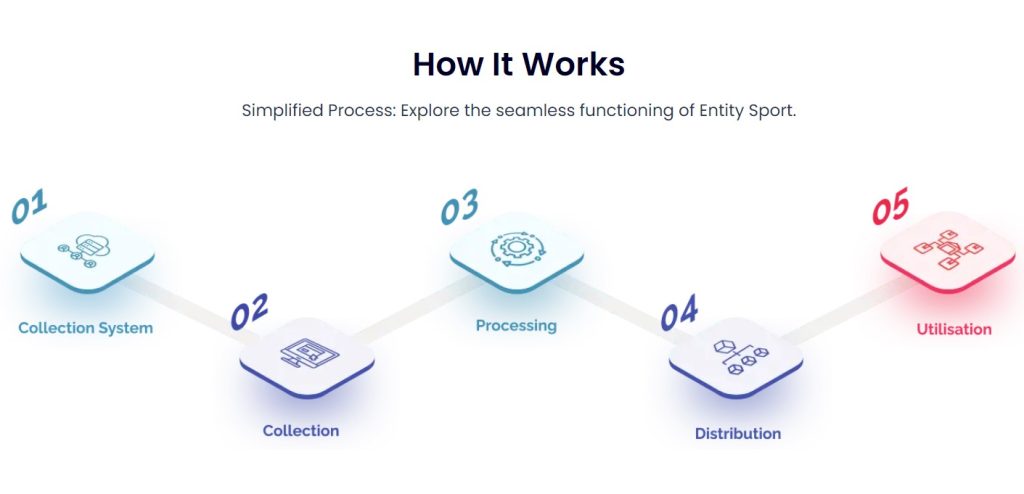
Behind the scenes, Entity Sport’s API undergoes a meticulous process of data aggregation and delivery:

Entity Sport’s API provides data for a wide range of sports, mainly covering Cricket, Football, Tennis, Basketball, Kabaddi, and Hockey. Additionally, it offers partial coverage of Baseball and American Football, expanding its reach across diverse sporting domains.
All the sports combined cover more than 1000+ competitions with 15,000+ matches annually under Entity Sports’ 200+ APIs and their endpoints.
For specifically cricket, here’s a guide for the tournament coverage provided by the Entity Sport Cricket API.
The reliability of data sources in Entity Sport’s API directly benefits users. For sports enthusiasts, it ensures an immersive and accurate experience. For bettors and fantasy sports players, it offers the edge they need to make informed decisions.
Moreover, Entity Sports API’s data sources benefit users in several key ways:

Entity Sport’s API gains a competitive edge through its distinct approach to data sourcing and aggregation. While many competitors rely solely on a single data source, Entity Sport takes a multifaceted approach to ensure data accuracy, comprehensiveness, and reliability. By combining data from official governing bodies, live data feeds, historical archives, user contributions, and statistical analysis, Entity Sport’s API assembles a data ecosystem that is unparalleled in the sports data market. This diversity in data sources guarantees that users receive the most up-to-date and comprehensive information available.
With the diversity of Entity Sports API in different aspects other than the data collection and delivery process like verification of the data by a team of expert data analysts, refining the data in an more easier and calculated way, providing rapid help support, also giving in-built or readymade sports data widgets to ease the integration process to your app or website.
Ultimately, Entity Sport’s unique approach to data aggregation and sources results in a comprehensive, accurate, and engaging user experience, benefiting not only sports enthusiasts but also sports odds, fantasy sports, and other related industries. This competitive edge in the sports data market positions Entity Sport as a trusted provider in an ever-expanding and data-hungry sports ecosystem.
In the grand arena of sports data, Entity Sport’s API emerges as a champion. The sources of its sports data provide a foundation built on reliability and accuracy. This, in turn, offers users the opportunity to experience sports in all its glory, from every angle. As the final whistle blows on this exploration, we’re reminded that data isn’t just numbers on a screen; it’s the essence of the sports we love.
For more information on Entity Sport’s API and its sports data, visit Entity Sport’s Documentation.
Entity Sports API sources data directly from official governing bodies like ICC, FIFA, and NBA, and cross-verifies it through internal quality control mechanisms before delivery. This means you’re getting data that’s as close to the source as possible.
Entity Sports API integrates with live data streams that capture match events minute-by-minute with the help of WebSocket. For most sports, updates reflect in a second of an in-game event — a goal, a wicket, a point — ensuring your app stays in sync with the action.
Entity Sports API covers 1000+ competitions and 15,000+ matches annually across sports like Cricket, Football, Tennis, Basketball, Kabaddi, and Hockey — including regional and domestic leagues, not just marquee events.
Yes. The historical archives are curated and cleaned — inaccuracies removed, formats standardized — making them reliable for statistical analysis, predictive modeling, or any data-heavy feature you’re building.
In the fast-paced world of sports, keeping your website’s audience updated with a real-time football score is essential. Whether you’re a sports news website, a fan community, or running a fantasy football league, integrating Football APIs for live score updates can enhance user experience and keep visitors engaged. In this guide, we’ll walk you through the process of using a sports API to provide live score updates on your website, focusing on Entity Sport’s Football API.
First, let’s start with what a Football API actually is. An API (Application Programming Interface) is a set of rules and protocols allowing different software applications to communicate. In the context of football, an API provides access to a vast database of real-time and historical football data, including scores, player statistics, team information, and more. Think of it as a football data feed that keeps your platform continuously updated with the latest match information. Entity Sport’s Football API, for example, provides a treasure trove of data, including more than 100 leagues, 10,000 matches from over 100 countries, and features such as live scores, player stats, rosters, competition stats, team stats, and fantasy points data.
Integrating live score updates on your website offers several advantages:
Real-Time Engagement: Users can follow every live football score and stay engaged with your website, spending more time browsing your content.
Enhanced User Experience: Live scores provide immediate information, catering to the needs of football fans who crave up-to-the-minute updates.
Increased Traffic: Live scores can attract more visitors to your website, especially during popular matches and tournaments.
Competitive Edge: If you’re running a fantasy football platform, providing real-time data helps users make informed decisions and stay competitive.
If you’re just getting into the business of sports data, here’s an in-depth guide on Football API to get you familiar with the world of sports interfaces.
Here’s how you can use Entity Sport’s Football API to display live score updates on your website:
Start by selecting Entity Sport’s Football API, a reliable provider that offers a comprehensive set of data, including real-time scores, fixtures, team and player information, and other relevant data points.
To access Entity Sport’s API, you’ll typically need an API key. Register with Entity Sport to obtain your unique API key. This key will be used to authenticate your requests to the API.
Login to Dashboard –>Applications
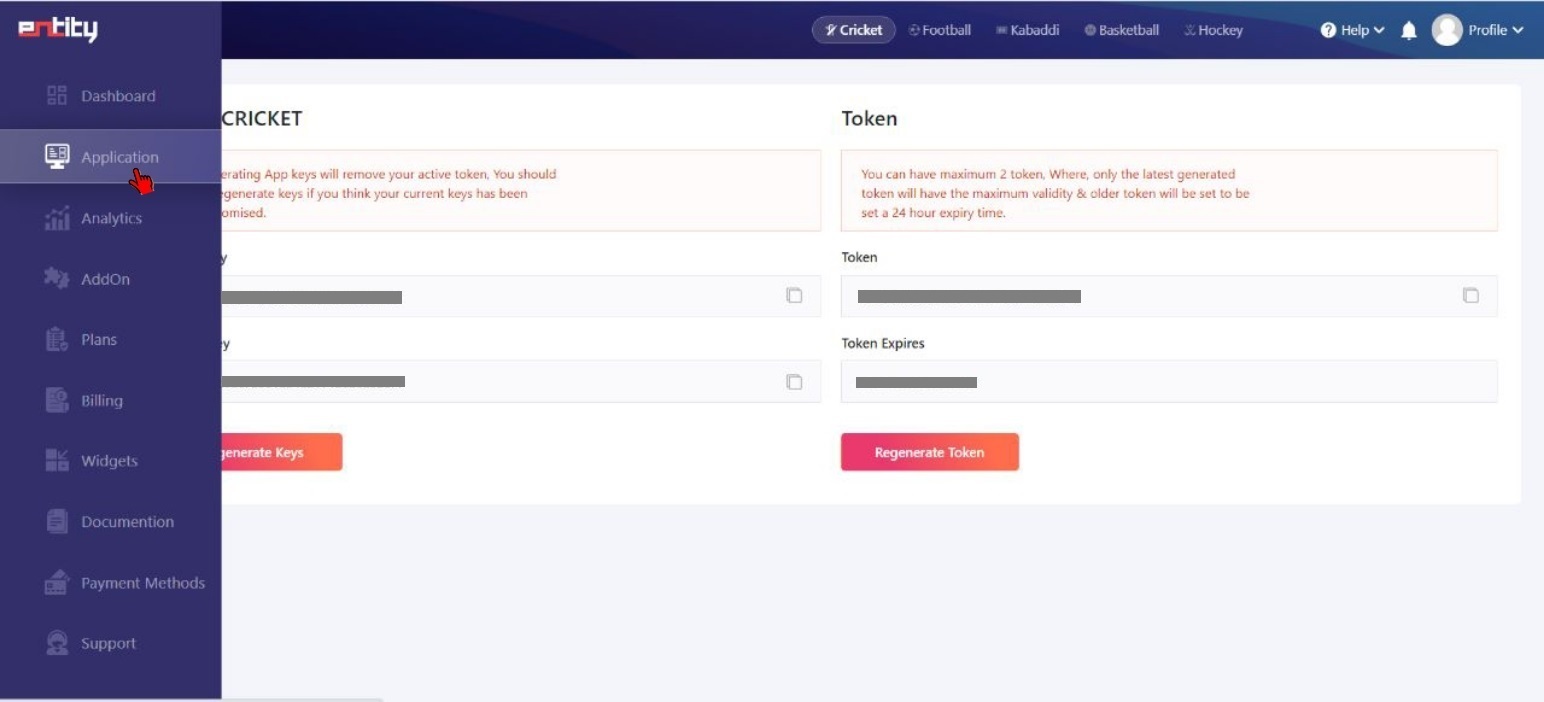
Applications–>Token
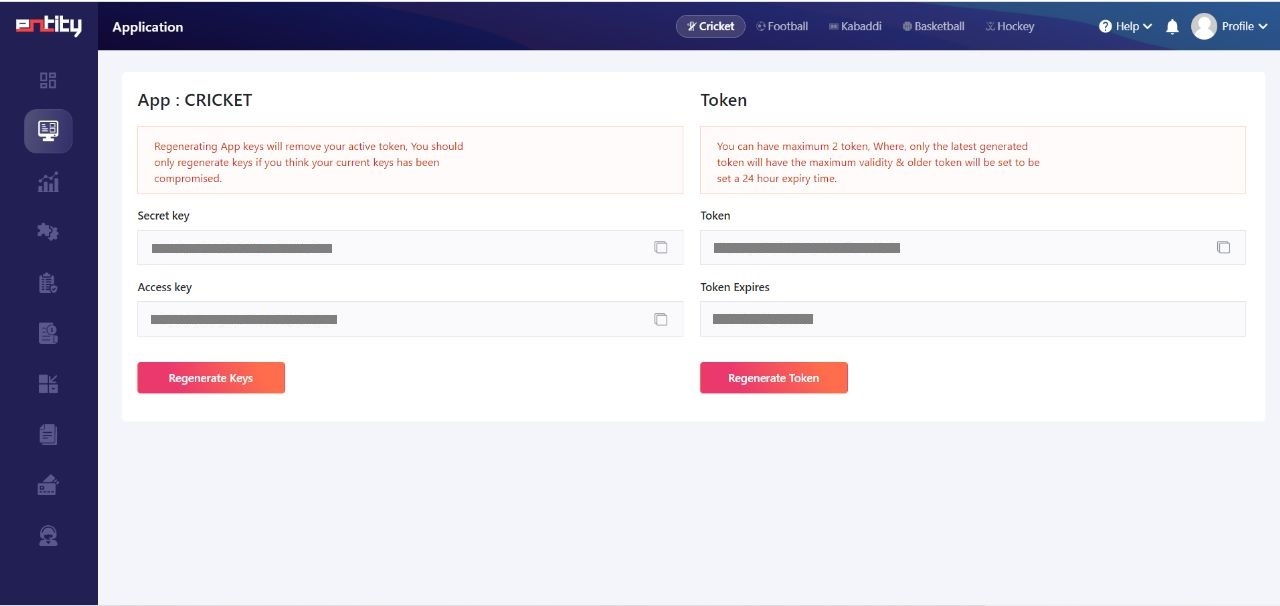
Familiarize yourself with Entity Sport’s API documentation, which will provide details on how to make requests, what data is available, and any specific requirements for integration.
Depending on your technical expertise, you can choose to develop a custom solution or use existing plugins or libraries for your website platform (e.g., WordPress, Joomla, or custom-coded websites).
Using your Entity Sport’s API key, make requests to fetch the live score data you need. Entity Sport’s Football API offers a wide coverage, including schedules, live scores, player stats, rosters, and more.
It’s straightforward to request data from the Entity Sports Football API. You can make a request by passing the access token that you got from the API Key to our API Server to get access to a live football data feed.
Here’s an example of a sample request.

Once you have the data, display it on your website in a user-friendly format. You can create a live football score widget or a dedicated scores page or integrate it into existing football-related content.
Set up a mechanism to regularly update scores in real-time, ensuring your users receive the latest information without delay.
Optimize for Mobile: Ensure that your live scores delivered via the sports API are accessible and look great on mobile devices to cater to users on the go.
Customization: Consider offering customization options such as notifications for favorite teams or leagues.
Branding: Customize the appearance of the live score widget to match your website’s branding.
Legal Considerations: Be aware of any legal and copyright issues related to using live score data, and ensure compliance with Entity Sport’s terms and conditions.
By following these steps and tips, you can seamlessly integrate Entity Sport’s Football API for live score updates on your website, providing an enhanced user experience and keeping your audience engaged. Whether you’re a sports news website, a fan community, or a fantasy football platform, displaying a real-time football score can help you stand out in the competitive world of online sports content.
READ MORE:
How to Get Detailed Cricketer Profiles Using Entity Sport’s Cricket API?
Managing Errors and Ensuring Smooth Operation with Entity Sport’s Various Sports APIs
How to Create Informative Cricket Infographics using Entity Sport’s Cricket API Data?
Entity Sport offers a range of dynamic sports APIs, including the Cricket API, Football API, Basketball API, Baseball API, Kabaddi API, Hockey API, Volleyball API, and NFL API. While these APIs are incredibly valuable for keeping fans updated and engaged, there may be times when errors or hiccups occur.
So, how can you ensure a smooth experience for your users with Entity Sport’s APIs and get the assistance you need? Let’s dive into some practical tips on handling errors and accessing support and solutions from Entity Sport.
Before we explore the support options, let’s understand the common errors that can occur when working with Entity Sport’s sports APIs:
1. Connection Issues: Temporary hiccups in data flow due to network problems or server unavailability can disrupt your application’s operation.
2. Authentication Challenges: APIs often require authentication. If your credentials are incorrect or outdated, it can lead to authentication errors.
3. Rate Limiting Problems: Exceeding the rate limits set by the APIs can result in rate-limiting errors, limiting your access to the data.
4. Data Format Mismatches: The data provided by the API may sometimes differ from what your app expects, causing data parsing errors.
5. Server-Side Errors: Occasionally, server-side issues, such as misconfigurations or infrastructure problems on Entity Sport’s end, can cause errors.
6. Timeout Errors: These occur when a request takes too long to complete. It could be due to network issues, server overload, or a slow response from the API.
7. Invalid Parameters: If you send incorrect or missing parameters in your API request, you’ll receive an error. This error might include details about which parameter is causing the issue.
8. Access Denied: This error indicates that you don’t have the necessary permissions to access a specific resource or perform a particular action. It often results from authentication or authorization issues.
9. Data Not Found: Sometimes, you might request data that doesn’t exist. The API will return an error indicating that the requested resource was not found.
10. Conflict Errors: These occur when there’s a conflict in the data, such as attempting to create a resource that already exists or updating a resource with outdated data.
11. Too Many Requests: APIs often have rate limits to prevent abuse. If you exceed the allowed number of requests within a specific time frame, you’ll receive a “too many requests” error.
12. Internal Server Errors: These are issues on the API provider’s end. They could result from misconfigurations, server outages, or other internal problems.
13. Maintenance Errors: Some APIs undergo maintenance, and during that time, they may be temporarily unavailable. Users may encounter a “maintenance” or “service unavailable” error.
14. Security Errors: These errors occur when an API detects suspicious or unauthorized behavior, such as multiple failed login attempts or unexpected changes to data.
15. Validation Errors: These errors are specific to the data you send to the API. They occur when your data doesn’t meet the API’s validation criteria.
16. Unexpected Responses: Sometimes, an API might return responses that you didn’t anticipate. This can be due to changes in the API or incorrect assumptions about the data format.
Note: It’s important to note that Entity Sports APIs document these error codes and messages in their documentation, making it easier for developers to understand and handle them.
Here’s how you can manage errors and ensure a smooth operation while using Entity Sport’s sports APIs and access the support you need:
1. Friendly Error Messages: When something goes wrong, your application should provide clear and user-friendly error messages. If you encounter difficulties, Entity Sport’s support team can help you interpret these messages and provide solutions.
2. Connection Monitoring: Implement monitoring and alert systems to track the status of your application’s connections to Entity Sport’s APIs. This allows you to identify and address issues proactively.
3. Rate Limiting Compliance: Stay within the rate limits set by Entity Sport’s APIs to avoid rate-limiting issues. Entity Sport’s support can guide you on best practices for optimizing your API usage.
4. Regular Authentication Check: Keep your authentication credentials up to date. If you’re facing authentication issues, Entity Sport’s support team can assist you in verifying your credentials and ensuring they’re correct.
5. Logging and Monitoring: Utilize logging and monitoring tools to keep an eye on your application’s performance and identify potential problems. Entity Sport’s support team can help you set up effective monitoring strategies.
6. Fallback Data Planning: Prepare for potential data interruptions by providing fallback data or informative messages to users. Entity Sport’s support can guide you on strategies for maintaining user engagement during data disruptions.
7. API Version Updates: Stay informed about API version updates and changes. Entity Sport’s support team can assist in transitioning to new API versions to prevent errors related to deprecated versions.
8. Clear Documentation: Entity Sport provides clear and comprehensive documentation for their APIs. When you encounter errors or challenges, refer to the documentation for guidance. If you have specific questions, Entity Sport’s support team can provide clarifications.
9. Reach Out for Support: If you encounter complex errors or challenges that can’t be resolved through documentation or self-help, don’t hesitate to reach out to Entity Sport’s support team. They are readily available to assist with troubleshooting and problem-solving.
Entity Sport takes your experience seriously and offers a range of support and solutions to ensure your success:
Test Account: Entity Sport provides a test account for you to evaluate their APIs before making a purchase. This allows you to get a feel for the APIs and ensure they meet your requirements.
24/7 Support: Their support is available 24/7 through chat, call, and email. Whether you’re facing issues at midnight or during the day, they have your back.
Developer-Side Solutions: Entity Sport offers developer-side solutions to assist you in integrating their APIs seamlessly into your applications. They can provide guidance and code samples to make your development process easier.
Design Solutions: If you need design solutions to create user-friendly and visually appealing sports-related content or applications, Entity Sport has you covered. Their design team can work with you to bring your ideas to life.
Digital Marketing Solutions: To help you reach a broader audience and promote your sports-related content, Entity Sport offers digital marketing solutions. They can assist you in creating effective marketing strategies tailored to your specific goals.
While using Entity Sport’s diverse range of sports APIs, managing errors and ensuring smooth operation is a collaborative effort. By following best practices and leveraging the support and solutions provided by Entity Sport, you can maintain a seamless and error-free experience for your users.
READ MORE:
The Future of Cricket Apps with Entity Sport’s API
How to Get ICC Cricket World Cup and ODI Cricket World Cup Data through Cricket API?
How to Boost User Engagement with Entity Sport’s Cricket API?
Ask a hundred people to name the world’s best sport and the argument will go on for hours. Ask a billion football fans the same question, and the answer is immediate. Here are 20 reasons why—and a look at how Football APIs and football data providers are deepening how fans, platforms, and businesses connect with the game.
Two halves. Ninety minutes. Eleven players a side. Simple enough for anyone to follow, deep enough to sustain a lifetime of tactical debate. There are no complex scoring systems to decode, no prolonged stoppages, no rotation of play. The game flows from first whistle to last, and that continuity is what keeps fans locked in.
Ronaldo. Messi. Mbappé. Football has produced some of the most gifted athletes in history, and watching them perform at pace, under pressure, in front of thousands is genuinely compelling. A Football API brings that individual brilliance into focus—player stats, career records, and match-by-match breakdowns that show exactly how good these players really are.
FIFA governs football across more than 200 member associations, and the consistency that it provides is what makes a global World Cup possible. Football data APIs integrate FIFA-related data directly—tournament schedules, qualification standings, historical records — making that structure accessible to fans everywhere.
No sport generates commercial value like football. The fan base is global, match windows are predictable, and the emotional investment is unmatched. For brands, football is one of the few platforms where you can reach a billion people simultaneously and have them actually paying attention. Football data providers sit at the centre of this ecosystem — powering the sponsorship analysis and audience data that brands and rights holders rely on.
The World Cup. The Champions League. The Copa Libertadores. The African Cup of Nations. Football’s calendar is packed with competitions that carry history and stakes fans care about deeply. Each tournament has its own identity, its own drama, its own defining moments. There is always something to follow, and always something on the line.
Football’s financial rewards attract the best athletes and fund elite setups at every level of the game. The prize pools at major tournaments reflect the sport’s commercial scale, and the salaries on offer create fierce competition for talent. Football data feeds track the financial side too — transfer values, contract data, earnings benchmarks — for analysts and journalists covering the business of the sport.
The Maracanã. Camp Nou. Wembley. San Siro. These are institutions, not just venues. Walking into a historic football stadium carries a weight that few sporting experiences can match — the atmosphere, the architecture, and the memory of what has happened on that pitch all combine into something genuinely unique.
Get the ball in the net. Do not use your hands. The rules have been refined over more than a century, but the core remains accessible to anyone without an instruction manual. That simplicity is why football is played in every country in the world, from professional stadiums to barefoot games on dusty streets, and why it travels so effortlessly across cultures.
Football and pub culture are inseparable in much of the world. Fans gather before kick-off, argue at half-time, and either celebrate or commiserate when the final whistle blows. It is a social ritual that turns strangers into temporary allies and rivals into friends. Football data providers power the screens that fans are watching—live scores and match events displayed in real time.
The 2023 FIFA Women’s World Cup drew record global audiences. Domestic leagues are growing. Women’s football is no longer a footnote—it is a headline, and football data providers are covering it accordingly.
Football has been part of the Olympics since 1900, making it one of the longest-running events in the Games’ history. The men’s and women’s tournaments, with overage allowances that bring established stars into the competition, add a distinctive dimension to an already packed football calendar. Football APIs covering Olympic competitions give fans access to tournament data and player stats from one of the sport’s most unique formats.
Latin American football has developed multi-stage formats that create sustained drama across an entire season. Group stages, aggregate ties, home-and-away knockouts—football data providers track every result, and standings update across all of it.
Football generates more media content than any other sport. Every transfer rumour becomes a story. Every press conference becomes a headline. Every match generates a week’s worth of analysis across news outlets, podcasts, social platforms, and beyond. Football data APIs give media operations the real-time information they need to publish accurate, timely content at the pace the sport demands.
Every four years, the world stops for a month. The FIFA World Cup is the most-watched sporting event on the planet—bigger than the Olympics, bigger than the Super Bowl, bigger than anything else. Nations that rarely agree on anything find themselves united behind a football team, and that unity, however temporary, is one of the most remarkable things sport can produce.
A 1-0 lead means nothing until the final whistle. Late equalisers, injury-time winners, penalty shootouts—no other sport keeps its outcome uncertain for as long. That uncertainty is not a flaw in football’s design. It is the whole point.
Wheelchair football. Blind football. Amputee football. These are not afterthoughts—they are organised competitions with governing structures, international tournaments, and dedicated fan bases. They reflect the sport’s genuine reach across different communities, and they are part of what makes football’s identity broader than any other sport.
The gap between playing football and playing it well is enormous. Precise passing, first touch, spatial awareness, set-piece delivery—elite footballers spend years developing skills that look effortless at pace. Football APIs surface that skill in data—passing accuracy, chance creation, duel success rates—numbers that reveal what the eye alone cannot.
Elite footballers cover ten to thirteen kilometres per match, sprinting and changing direction hundreds of times. Soccer data feeds increasingly include physical performance metrics—distance covered, sprint counts, intensity zones—giving analysts a window into the athletic side of the game.
Football requires nothing but a ball. Grass, concrete, sand, artificial turf—it is played everywhere, at every level, in every climate. No other sport has managed to make itself this accessible across this many different contexts, and that is a big part of why football’s global footprint remains unmatched.
The best teams are rarely those with the most individual talent. Organisation, trust, and collective effort win matches—Leicester City won the Premier League, Greece won the Euros. Soccer data providers capture those collective dynamics, from pressing intensity to passing networks, telling the story of how a unit wins together rather than how individuals performed apart.
Twenty reasons, one conclusion: football is the best sport in the world because it is everything at once. Simple and complex. Local and global. Individual and collective. It generates passion at a scale no other sport matches, and it has done so for over a century.
Football data providers and Football APIs are part of how the sport keeps growing—connecting fans to matches they cannot attend, giving platforms the data they need, and ensuring that wherever you are in the world, football is always within reach.
The UEFA Europa League runs every year. Millions of fans follow it across Europe and beyond. Clubs fight through qualifying rounds, group stages, and knockout ties, and every match generates data that football fans want the moment it happens. If you are building a platform to serve those fans, the one thing you cannot afford to get wrong is your data pipeline. Get it right, and your platform works. Get it wrong, and your users notice immediately. That is where a Football API comes in.
A Football API is the pipeline between a live football data source and your platform. Your app fires a request. The sports data API fetches exactly what you asked for—scores, lineups, stats, and standings—and returns it in a structured format your system can immediately use.
The Europa League does not produce a trickle of data. Every match generates a constant stream of events—goals, cards, substitutions, lineups, live standings—that users expect to see the moment they happen.
You cannot manage that manually. The only real solution is a live football data feed that handles the pipeline automatically, accurately, and without delay.
When it comes to the UEFA Europa League specifically, Entity Sport is the data provider worth knowing about. Football API coverage is organized into four levels, and the Europa League sits at Level A, the highest tier. That means you get the full suite of data across all three plan types (Starter, Pro, and Elite), not a trimmed-down version.
Here is what that coverage actually includes:

Lineups — Know exactly who is starting before the whistle blows. Entity Sport delivers confirmed team lineups as soon as they are officially released, so your users are never guessing. In the Europa League, where squad rotation is constant, lineup data is one of the most requested features on any platform.
Formation — Tactical context matters to football fans. Formation data gives your platform the ability to show how a team is set up, not just who is playing. It is the difference between a platform that informs and one that actually engages.
Play-by-Play Commentary — The moment-by-moment breakdown of a match. This is the backbone of any live match experience, and Entity Sport delivers it in real time with low latency. Users who cannot watch the game live rely on this entirely; it has to be fast and accurate.
Live Table — Standings that update automatically as results come in. The Europa League table shifts fast, and with multiple groups running simultaneously, a stale standings table is one of the quickest ways to lose user trust.
Passing Stats — Who is moving the ball and how! Passing data adds a layer of analytical depth that separates serious platforms from basic score apps. It is the kind of stat that keeps analytically minded users coming back.
Attack Stats — Shots, chances created, attacking actions. A team can win 1-0 and completely dominate; attack stats show that. The scoreline is a summary; this is the full story.
Defense Stats — Tackles, interceptions, clearances. Defensive data is often the most underserved area on football platforms. Entity Sport covers it properly. For users building tactical analysis tools or scouting features, this data is essential.
Duels — Ground duels, aerial battles, and determining who is winning the physical contests. In knockout rounds, especially, duel stats often predict the result before the final whistle. A small data point that makes a big difference.
Goalkeeping Stats — Saves, distribution, high claims. Europa League knockout ties are regularly decided by a single save; your platform should be able to tell that story. Goalkeepers are decisive in this competition, and their stats deserve dedicated coverage.
Real-Time Scores — The non-negotiable. Entity Sport treats latency as the highest priority. A goal goes in, and your platform knows about it within seconds. Everything else on this list matters, but if the score is wrong or delayed, none of it counts.
Match Events with Player Details — Every card, goal, assist, and substitution is attributed to the right player with full detail. Attribution matters; users want to know who scored, not just that a goal happened. This is what powers live event feeds, fantasy sports, and match timelines.
Competition Roster — The full list of registered players for the competition. Europa League squads shift across the group stage and knockouts; this data keeps your platform accurate at every stage. Essential for any platform building out team or player pages.
Team Roster — Squad-level data per team, updated and accurate throughout the tournament. Whether a user is checking depth charts or scouting a specific club, team roster data is one of the most visited sections on any football platform.
That is thirteen data points, all live, all structured, all available through a single API. Most platforms need every one of them.
Entity Sport’s live football data platform is built across several modules, each covering a specific layer of data:
• Livescore Football API — Real-time Europa League scores, commentary, events, lineups, and projection data.
• Soccer Schedule API — Upcoming fixtures, live matches, and results in one place.
• Competition List API — All active, upcoming, and completed competitions are accessible from a single endpoint.
• Match Statistic API — Player and team stats across 50+ data types, including passing, defense, attack, and duels.
• Competition Statistic API — Cumulative player stats across all matches in a tournament.
• Live Points Table API — Standings that update the moment a result comes in.
• Team API — Team profiles, player rosters, and match history.
• Player API — Individual player profiles and full career statistics.
• Football Fantasy Points API — Real-time fantasy point calculations as match events unfold.
The market has options. Here is what makes Entity Sport worth choosing.
Data goes out the moment the action happens — no batch delays, no scheduled refreshes arriving three minutes late. Always live is not a feature here; it is the baseline.
Bugs and outages do not schedule themselves around business hours. Entity Sport’s support team is available 24/7, and they actually respond.
From fantasy points to player career stats to fast live football data, the feature set is broad. There is not much a football platform needs that is not covered.
Football API Plans are priced to work for businesses at different stages — a startup and an established platform do not pay the same rate. And coverage spans domestic leagues, international competitions, and everything in between.
Entity Sport offers a free test account so you can evaluate the sports API before signing up for anything. You get access to full historical data from the following competitions:
1. Allsvenskan 2018 — Sweden
2. Eliteserien 2018 — Norway
3. Chinese Super League 2018 — China
Entity Sport issues a token that gives you access to these matches. Integrate it, check how the data appears on your platform, and confirm it fits what you are building. The Football API documentation section on Entity Sport’s website walks you through the full process.
4. Sign up for an Entity Sport account.
5. Verify your email address.
6. Log in with your details.
7. Choose and subscribe to a plan from the dashboard.
The UEFA Europa League commands a global audience every single year. Platforms built to serve that audience need data that is fast, complete, and always on.
Entity Sport is the football data provider that gives you the infrastructure to deliver exactly that coverage deep enough to power anything from a live score app to a full fantasy sports platform, at pricing that actually makes business sense.
Stop working around the data problem. Start building on something that has already solved it.
A Football API is the pipeline between a live football data source and your platform. Your app sends a request, and the API returns exactly what you need — scores, lineups, stats, standings — in a structured format your system can immediately use. The Europa League generates a constant stream of live events across every match, and the only reliable way to deliver that to users in real time is through a live football data feed that handles the pipeline automatically.
Entity Sport covers thirteen data points for the Europa League, including real-time scores, lineups, formations, play-by-play commentary, live standings, passing stats, attack and defense stats, duels, goalkeeping stats, match events with player attribution, and both competition and team rosters. The Europa League sits at Level A — the highest coverage tier — meaning all of this is available across every plan.
Entity Sport’s platform is built across several modules: Livescore Football API, Soccer Schedule API, Competition List API, Match Statistic API, Competition Statistic API, Live Points Table API, Team API, Player API, and Football Fantasy Points API. Together they cover every data layer a football platform could need through a single integration.
Yes. Entity Sport offers a free test account with full access to historical data from three competitions — Allsvenskan 2018 (Sweden), Eliteserien 2018 (Norway), and the Chinese Super League 2018. You receive an API token, integrate it with your platform, and evaluate the data structure and performance before choosing a paid plan.
Getting started takes four steps: sign up for an Entity Sport account, verify your email, log in, and subscribe to a plan from the dashboard. Full API documentation is available on the Entity Sport website to guide you through the integration process from start to finish.
Twice a year, Europe’s best senior national football teams settle something the friendly circuit never quite could: who actually belongs at the top. The UEFA Nations League is a full-scale competition organized by UEFA, featuring senior men’s national teams battling through a league format with real consequences—promotion, relegation, and a direct route to glory. And the only reliable way to deliver that data to a global audience in real time is through a live Football API.
For developers and business owners building a website, app, or sports platform around this tournament, the question is never whether to offer this data. The question is how to get it reliably, fast, and without building an entire football data feed infrastructure from scratch.
A Football API is a data delivery system. On one end, a server packed with structured football data—match results, player stats, live scores, team info, fantasy points, competition standings. On the other end, your application, which needs all of it to actually work.
The API sits in the middle. Your platform fires a request. The API goes and gets exactly what was asked for, returns it in JSON or XML, and your application takes it from there. Fast, clean, no manual input required.
Think of it like a club’s transfer scout. You brief the scout on exactly what you need—position, stats, age, and availability. He disappears into the market, does all the legwork nobody sees, and comes back with the right player packaged and ready. A sports data API does the same thing, except it never gets the position wrong—unless you hired the wrong scout, in which case, good luck explaining that to the board.
The UEFA Nations League does not produce a trickle of data. It produces a flood. Live scores, goal events, lineups, substitutions, standings, player stats—every match generates a constant stream of updates that users expect to see on their screens the moment they happen.
Doing that manually is not a strategy. It is chaos.
A Live Football API handles the entire pipeline. It pulls every update from the source the moment it occurs and delivers it to your platform in a format that is immediately usable. No lag, no human error, no team of people refreshing official pages at 2 AM.
Developers stop worrying about infrastructure. Business owners stop worrying about content. The data shows up, accurately and on time, and the platform does what it is supposed to do.
Entity Sport’s Football API covers every layer of data a football platform could need. Live score app, fantasy sports platform, media outlet—this Live Football API has a module for all of it.
Low latency is the whole game here. Entity Sport’s Livescore Football API delivers real-time scores, commentary, match events, lineups, and projection data as the action happens on the pitch.
Football audiences are not forgiving about delays. A goal goes in, and users expect their screen to know about it within seconds. Entity Sport treats latency as the highest priority—not a footnote in the spec sheet.
What is on next. What just finished. Users want both, and they want them without having to dig for it. The Soccer Schedule API delivers upcoming fixtures, live match data, and previous results in a format that is easy to surface on any platform.
Disorganized fixture data is one of the fastest ways to lose users. Entity Sport structures this so your platform does not have to.
Your users do not all follow the same competition. The Competitions List API gives your platform access to all upcoming, active, and completed football competitions in one place, so you are not managing a separate data stream for every league you want to cover.
The scoreline is a summary. The Match Statistic API is the full story—passing stats, defensive actions, attacking figures, duels, and more, broken down by player and team.
It is structured and organized, which means users find what they are looking for without wading through data that is not relevant to them.
Individual match stats only go so far. The Competition Statistic API tracks player performance across an entire tournament—total goals, assists, cards, minutes played—and makes it available on demand. Entity Sport keeps these records updated continuously throughout a competition.
In the UEFA Nations League, the standings table is not just a table. Promotion and relegation between leagues mean every point shift carries real weight. The Live Points Table API updates the standings automatically as results come in, so your platform is never showing yesterday’s picture.
Team profiles, player rosters, match-by-match data—the Team API covers it all through a single endpoint. Everything needed to build a proper team page, without stitching together data from multiple sources.
Some users come for the team. Others come for a specific player. The Player API delivers detailed player profiles and full career statistics on demand, whenever your platform needs to go that deep.
Fantasy football is no longer a side product. It is a primary use case for a lot of platforms, and the data requirements are non-trivial. Entity Sport’s Football Fantasy Points API calculates and delivers soccer match fantasy points in real time as events unfold on the pitch.
No need to build a custom points engine. Entity Sport handles the calculation; your platform handles the display.
The market has options. Here is what actually makes Entity Sport worth choosing:
• Always Live — Data goes out the moment the action happens. No queuing, no batch delays, no waiting for a scheduled refresh that arrives three minutes too late.
• 24/7 Support — Bugs and outages do not schedule themselves around business hours. Entity Sport’s support team is available around the clock, and they actually respond.
• Best Features — Player stats, team data, competition statistics, fantasy points, and fast live scores across multiple sports. Very little is left uncovered.
• Affordable Business Pricing — Plans are priced to work for businesses at different stages. A startup and an established platform are not paying the same rate for the same data.
• Widest Coverage — Domestic leagues, international competitions, everything in between. You pick what your audience cares about; Entity Sport covers it.
Not ready to commit? Entity Sport offers a test account so you can see how the football data feed API actually performs before signing up for anything. You get access to historical league data in full—enough to evaluate whether the output meets your requirements.
The test account includes the following competitions:
• Allsvenskan 2018 — Sweden
• Eliteserien 2018 — Norway
• Chinese Super League 2018 — China
Entity Sport issues a token that gives you access to these matches. Integrate it with your platform, see how the data appears, and check whether the structure fits what you are building. The Football API documentation section on Entity Sport’s website walks you through the whole process.
Satisfied with the test? Moving to a paid subscription takes four steps:
1. Sign up for an Entity Sport account.
2. Verify your email address.
3. Log in with your details.
4. Choose and subscribe to a plan from the dashboard.
The UEFA Nations League draws audiences from across the world, twice a year, without fail. Any platform built to serve those audiences needs football data that is fast, accurate, and always on. That is not negotiable.
Entity Sport’s football data solution gives you the infrastructure to deliver exactly that, at a price that makes business sense. Stop working around the data problem and start building on something that has already solved it.
A Football API is a data delivery system that connects your platform to structured football data — live scores, player stats, match events, standings, and more. Your application sends a request to the API, which fetches the relevant data and returns it in JSON or XML format, ready to use. No manual input, no infrastructure headaches.
The UEFA Nations League generates a constant stream of live data — goals, lineups, substitutions, standings shifts, and player stats — across every match. A Live Football API handles the entire pipeline automatically, delivering updates to your platform the moment they happen, so you never have to manage the data manually or risk falling behind on live action.
Entity Sport covers everything a football platform needs — live scores, fixtures, match statistics, competition standings, team and player profiles, career stats, and real-time fantasy points. Whether you are building a live score app, a fantasy platform, or a media outlet, all of it is available through a single integration.
Yes. Entity Sport provides a test account that gives you access to historical league data — including Allsvenskan 2018, Eliteserien 2018, and the Chinese Super League 2018 — so you can evaluate the data structure and API performance before signing up for a paid plan.
Getting started takes four steps: sign up for an Entity Sport account, verify your email, log in, and choose a plan from the dashboard. Full documentation is available on the Entity Sport website to guide you through the integration process.

