


Introduction
The NFL is not just America’s biggest sport anymore — it is one of the biggest sports properties on the planet. Regular season games in London, Munich, and Sao Paulo sell out within minutes. Streaming deals now stretch across continents. The Super Bowl remains the single most-watched annual broadcast in the world, and every season the numbers climb higher — more viewers, more revenue, more countries tuning in from outside the United States.
That kind of scale changes what fans expect. A fan is no longer content to check the score after a drive ends. They want the play the moment it happens — the third-down conversion, the interception, the two-minute drill unfolding live on their screen while they are nowhere near a television. That urgency is the entire reason an NFL API exists. A platform that cannot deliver a touchdown the second it happens loses the fan to one that can.
This is where NFL API endpoints come in. Every touchdown alert, every live win probability meter, every fantasy leaderboard update on a Sunday afternoon is being pulled from a specific endpoint, built for a specific job. This guide walks through what an NFL API is, the features that matter, the NFL endpoints that make up a complete NFL data feed, and how Entity Sport’s NFL API covers every one of them.
Get Started with Our NFL Data Feed
NFL APIWhat Is an NFL API and How Does It Work?
An NFL API is a data service that delivers structured football data — live scores, play-by-play, player stats, team information, schedules — directly into an application or platform. Instead of building your own network of scouts, scrapers, and stat-trackers, you send a request to an endpoint and get back clean, structured data your app can use immediately.
Entity Sport’s NFL API, like the rest of the Entity Sport data feed, runs on a RESTful architecture. Developers send an HTTPS request to a specific endpoint, using an access token generated from their API keys, and get a JSON response back. That response updates continuously through the game — Entity Sport’s live score data refreshes every second, which is what lets a scoreboard NFL widget, a fantasy app, or a second-screen companion app stay in sync with what is actually happening on the field.
This is the part that separates real NFL API documentation from a marketing page — the actual mechanics of the request-response cycle, the token expiry windows, and the object structure (game IDs, team IDs, player IDs) that ties every endpoint together. Once a developer understands that structure, pulling schedule data, live scores, or player stats becomes a matter of knowing which NFL endpoint to call, not relearning the system each time. This is also why good NFL API documentation matters as much as the data itself — an NFL API for developers is only as useful as how clearly its endpoints, parameters, and response objects are laid out.
Also read:
NFL API Features
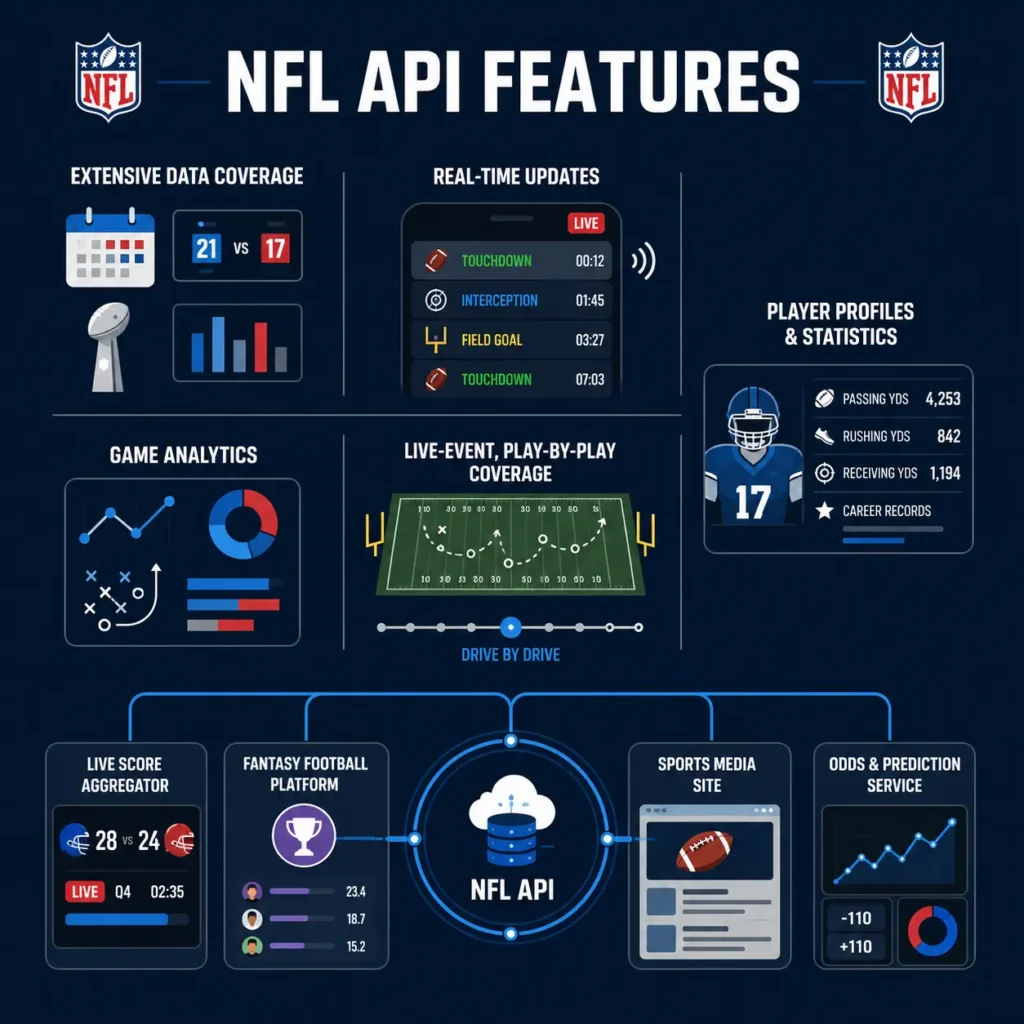
Before getting into individual NFL API endpoints, it helps to look at what a complete NFL data feed should cover. These are the features that show up across a serious NFL API provider’s offering:
- Extensive data coverage — game schedules, live scores, player statistics, team rankings, and historical data across regular season, playoffs, and the Super Bowl
- Real-time updates — instant delivery of touchdowns, interceptions, field goals, and other scoring plays as they happen
- Player profiles and statistics — passing yards, rushing yards, receiving yards, and career records across seasons and teams
- Game analytics — team performance trends, turnover rates, scoring patterns, and comparative stats
- Live-event, play-by-play coverage — drive-by-drive breakdowns that let a platform recreate the flow of the game, not just the final score
A feed that covers all of this becomes usable across very different products — a live score aggregator, a fantasy football platform built on an NFL fantasy API, a sports media site, or an odds and prediction service all pull from the same core feed, just weighted toward different endpoints.
NFL API Endpoints: The Full Breakdown
Entity Sport’s NFL API is built around eight NFL API endpoints. Each one owns a distinct part of the season — from the schedule to the final whistle to the fantasy scoreboard. Here’s the quick-reference table before we break each of these NFL endpoints down individually.
| NFL API Endpoint | What It Returns |
| Schedule API | Upcoming, live, and finished games with results |
| Livescore API | Real-time scores as the game unfolds |
| Player API | Player profiles and career statistics |
| Roster API | Full team rosters for the season |
| Competition API | Matches, rounds, standings, teams, and player stats |
| Team API | Team profiles, rosters, and match history |
| Match API | Match info, scorecards, statistics, and real-time events |
| Fantasy Points API | Live, continuously updated fantasy points per player |
Schedule API
The Schedule API is the starting point for almost every NFL platform. It returns upcoming, live, and completed games — filterable by team, week, or season — along with the unique match ID that connects to every other endpoint in the feed. Whether you are building a game calendar, a results page, or a pre-game landing screen, this is where the build starts.
Livescore API
This is the real-time layer of Entity Sport’s NFL API. The Livescore API delivers score updates as they happen — refreshed every second — so a live scoreboard, a second-screen app, or a push notification system never falls behind the actual game. For any platform built around live NFL data, this is the endpoint doing the heavy lifting on game day.
Player API
The Player API returns detailed player profiles and career statistics — passing yards, rushing yards, receiving yards, touchdowns, and records across seasons and teams. This is the endpoint behind player comparison tools, form trackers, and the stat-heavy pages that fans check before setting a fantasy lineup.
Roster API
The Roster API delivers full team rosters for the competition — every player on every team, tied to their position and team ID. Pair this with the Schedule API and you get a clean picture of who is playing before kickoff, which is essential for fantasy platforms building lineup screens.
Competition API
Where the Schedule API is game-first, the Competition API is season-first. It returns standings, rounds, teams, and aggregated player stats across the whole competition — the data that powers a playoff picture page, a division standings table, or a season-long stats leaderboard.
Team API
The Team API returns team profiles, rosters, and match history — the team-centric view of the data feed. This is the endpoint behind franchise pages, season performance dashboards, and head-to-head comparison tools that look at a team’s history rather than a single game.
Match API
The Match API is the most granular endpoint in the feed. It returns full match information — scorecards, detailed statistics, and real-time in-game events — down to the play level. If a product needs a complete play-by-play breakdown of a single game, this is the endpoint feeding it.
Fantasy Points API
The Fantasy Points API is Entity Sport’s NFL fantasy API — it delivers continuously updated fantasy points for every player, live, as the game is being played. This is the backbone of any fantasy football platform — the endpoint that turns a touchdown on the field into a points update on a user’s leaderboard within seconds. Any platform built around an NFL fantasy API lives or dies by how fast this endpoint updates.
Learn Everything About Our Competition Coverage
NFL API CoverageHow NFL API Endpoints Connect on Game Day
None of these endpoints work in isolation — on an actual NFL Sunday, they chain together. Here is what that looks like for a fantasy platform running a live contest:
- Schedule API — pull the week’s games and get the match IDs
- Roster API — confirm which players are active before kickoff
- Livescore API — track the score in real time as the game unfolds
- Match API — pull play-by-play detail for in-depth event tracking
- Fantasy Points API — update every user’s fantasy score as plays happen
- Player API — surface individual stat lines for post-game recap content
- Team API / Competition API — update standings and team records once the game ends
Once a developer understands how the match ID, team ID, and player ID connect across these endpoints, the whole system reads as a single coherent feed rather than eight separate calls.
Alse read:
Why Entity Sport Fits Every NFL API Category
Entity Sport is built to be a complete NFL API provider — not a feed that covers scores well and leaves stats or fantasy data as an afterthought. A few things make that concrete:
- Full endpoint coverage — schedule, live score, player, roster, competition, team, match, and fantasy points, all included on the plan, not split across gated tiers
- Genuine real-time delivery — live score data updates every second, which matters most during a two-minute drill or overtime
- Fantasy-first design — the Fantasy Points API is a first-class endpoint with its own real-time update cycle, not a value calculated after the fact
- Depth of player data — 50+ performance metrics per player, covering the level of detail fantasy platforms and stat-heavy media sites actually need
- Built for developers first — a free development token makes Entity Sport’s NFL API for developers easy to test before committing to a paid plan, backed by full NFL API documentation for every endpoint
For a platform evaluating NFL data providers, the practical question is rarely “does this provider have live scores.” Almost every provider does. The real question is whether one NFL data feed can cover the schedule, the live game, the player stats, the fantasy scoring, and the season standings without stitching together multiple providers — and that is where Entity Sport’s NFL API is built to hold up.
Conclusion
The NFL’s growth — record viewership, expanding global audiences, ever-rising broadcast numbers — has raised the bar for what fans expect from the apps and platforms built around the sport. Real-time delivery is no longer a nice-to-have; it is the baseline. Understanding NFL API endpoints — what each one returns and when to call it — is what separates a platform that keeps fans locked in from one that loses them to a faster competitor.
Entity Sport’s NFL API covers all eight endpoints under one token, with real-time updates and full NFL API documentation to get a build up and running quickly. If you’re evaluating NFL data providers for your next build, start with the free development access and test the full endpoint set yourself.
Get in Touch with Us
ConnectFrequently Asked Questions
What is an NFL API?
An NFL API is a data service that delivers structured football data — schedules, live scores, player stats, team data, and fantasy points — to an application through a set of endpoints, typically over a RESTful, JSON-based architecture.
What are the main NFL API endpoints?
Entity Sport’s NFL API is built around eight endpoints: Schedule, Livescore, Player, Roster, Competition, Team, Match, and Fantasy Points. Each covers a different layer of the season, from upcoming fixtures to live, play-by-play game data.
How real-time is Entity Sport’s NFL live score API?
Entity Sport’s NFL live score API updates every second, including live points tables while games are in progress, so scoreboard and second-screen apps stay in sync with what’s actually happening on the field.
Is there an NFL fantasy API included in the data feed?
Yes. The Fantasy Points API delivers live, continuously updated fantasy points per player throughout the game, making it a core part of Entity Sport’s NFL API rather than a bolt-on feature.
How do I access NFL API documentation and start testing?
Entity Sport provides full NFL API documentation covering every endpoint, along with a free development token for developers to test the API before committing to a paid plan. The free token covers most endpoints, with sample data for player and team-level detail.